Sunday, 13 December 2015

Autumn Moon: Pagan Danger?

'Mystic Halloween Market', 'pagan folk', heavy metal music - is that sort of festival an appropriate place for good Christian people? Or even "children of God: created in His image, fallen, redeemed, struggling, looking forward to renewal" to quote my own sidebar? Were we putting ourselves in dire spiritual danger by going to such a festival?

There are many - maybe you are one - to whom this has an obvious answer: for some it is obvious that paganism and the occult are spiritually dangerous; for others it is equally obvious that this is just empty superstition and intolerance, and that such festivals should be judged on their music alone.

A few thoughts:-

Firstly, for me the baseline is that Jesus is Lord. Whatever spiritual dangers might be associated with such things, Jesus is our rock and our protector.

On one level that is the final word, but as fallen people in a fallen world we have our own responsibility to take spiritual care. More on that a bit further down.

So, secondly, what issues and problems might the occult pose for a follower of Jesus? 

I think the first thing to say is that, in spite of its name (and the boozy skeleton shown above), the Mystic Halloween Market was much more about paganism than about the occult as such. In pagan circles Halloween is more associated with Samhain, marking the end of harvest and the beginning of winter - the 'darker half' of the year - than with any Christian, or ex-Christian, tradition of 'All Hallow's Eve' as a festival of the dead.

Nevertheless, occult links exist, and it is, I think, worth briefly looking at a couple of its issues. Occult practices cover a wide range of areas - overlapping with broader paganism in places - but I just want to focus on a couple of these. 

The first is an occult focus on death and communicating with the dead. For Christians, following Jesus is about life, life at its fullest, so focussing on death is facing the wrong way. Even the cross, apparently a symbol of torture and death, is seen as being transformed by Jesus' sacrifice into a sign of God's love and the life he brings.

Then, when it comes to communicating with the dead, the Christian viewpoint is that this is something to be done through prayer: if we believe that someone's spirit is with God then prayer is the way to tell what needs to be told and to feel their ongoing presence and comfort, along with God's. 

Attempting to short-circuit that through mediums, seances and even ouija boards can be seen as one or more of: futile, because the dead don't talk; or inconsiderate, because the dead are meant to be left to 'rest in peace' until the resurrection; or even dangerous, because you can end up communicating with something much nastier than you intended. 

The Old Testament ban on witches was almost certainly a ban on mediums, those who attempt to raise the dead - see the Witch of Endor - not on harmless, if eccentric, elderly ladies, nor any of the other groups an overly intolerant Medieval Church used it against.

Thirdly, what about paganism? The essential question for a follower of Jesus is: why worship the created instead of the creator? That said, paganism refers basically to a group of religions, many rehashed heavily for the modern age, which - like nearly all religions - have their good sides and their bad. The appropriately Christian approach is to celebrate what is life-affirming and to refrain from involvement in whatever denies life in its fullness for all. But avoid idolatry yourself.

The apostle Paul wrote the go-to passages on this (here and here) in his letter to the troubled church at Corinth, who were worried about taking part in idol worship by buying (suspiciously reasonably priced) meat from butchers close to temples where idolatrous sacrifices were taking place.

Paul strikes a balance: on the one hand food is a gift from God for our good; on the other taking direct part in idol-worship is disloyal to Jesus and his Body, and effectively a denial of the power of God. So the question is, what actions carry the danger of leading us to worship idols? 

If our conscience is clear and we can enjoy the good music of pagan folk, say, then we should give thanks to God for it. If our background is such that we are vulnerable to superstition and focussing on what is dark and unwholesome, then avoid it. If we find a pagan's take on the beauty of nature and the interconnectedness of all life to be life-affirming and reflecting glory on the creator who made it all that is a good thing. But if we find ourselves tempted to start prioritising natural things over people and over following Jesus, then that is a different matter. 

But really any problem is within ourselves, let's not blame someone else's belief for our flaws. It's a bit like a recovering alcoholic who is following Jesus: drinking beer or wine is likely a really bad idea for them, but for others there is no problem, in moderation. Paul even recommends a little wine for his protégé Timothy on one occasion, to settle his stomach. So do not judge others according to your own weaknesses.

So, my unsurprising conclusion (given that we went to the Autumn Moon Festival, sharing its site with the Mystic Halloween Market, in the first place) is that, so long as we put our trust in Jesus, paganism is nothing to fear. As Jesus' friend John once wrote: "God is love ... there is no fear in love; perfect love casts out fear." 

So take the light of Jesus with you, affirm life to its fullest wherever you may go, and may the grace and peace that comes from God the Father and from Jesus Christ be yours in all that you do in the days and weeks to come.

Friday, 11 December 2015

Autumn Moon Bands Day 2

Lyriel - Highlight of the festival
Back to Hamelin for the second day of the Autumn Moon music festival, not to mention the Mystic Halloween Market.

After getting up at 8am (groan!) for breakfast, we spent an enjoyable morning wandering around Hameln - a very pleasant little town, slightly touristy, the central area very close within the old town walls, with plenty of interesting things to see. Then, fortified by bread on a stick from the market, off to Sumpfblume  to start another day's music.


First up were Diabulus in Musica, a band who weren't in the original advertised lineup, I think, so we had no idea what they'd be like. As it turned out they were surprisingly good: a Spanish band playing orchestral-style FFM with a very pregnant-looking lead singer. Quite how she could sing like that with what must have been a pretty immobile diaphragm is a mystery. But they were an unexpected treat. The video clip above is very short and has poor sound, but it does nicely illustrate the singer's condition. Like many bands I enjoy, their sound includes light and dark, heavy and soft. If you click on the band name above and scroll to the bottom of the page there are some videos which give a better idea of their music.

After them we stayed in the Sumpfblume for Ravenscry, another FFM band from the Mediterranean, this time from Italy. They'd seemed quite reasonable on the preview video, but live they were painful. Bass and twin guitars all turned up to 11 on both fuzz and volume. No colour, no inventiveness and no sign of originality in the first two songs, so we left them to it.

Across to the Rattenfängerhalle for some supposed cyberpunk-rock, with Dope Stars Inc. Actually fairly generic punk-pop, even emo-pop: heavy on eyeliner and hype, light on originality. Okay, but not exciting.

Staying put, we had a change in style with Clan of Xymox, a kind of gothic OMD: 80's synth-rock, or maybe pomp-rock, brought slightly more up-to-date. Not really my thing but actually done quite well, I thought. In fact, they reminded me that I quite liked OMD back in the day.


I'm starting to get very tired at this point, so it was handly that the next band we wanted to see, Mythemia, were back in the Schiff, where I hoped to get a bit of a sit-down. No chance! Storytelling folk in a mix of German and English, based around myths and legends (hence the name, I guess), so lively and well-played there was no way I could stay sat down at the back. Brilliant, a real treat! If you get a chance to see them yourself, then do.

We had thought about about heading back to the Rattenfängerhalle next to see Leaves Eyes, the one band at the festival that we had seen before: Scandinavian symphonic FFM, with a new album out which had been receiving good reviews. But I was just totally shot, and going nowhere.


So we stayed on the boat and watched Laura Carbone instead; I'm really pleased we did, although I ended up back on my feet again. She's a female indie-rock singer, reminiscent to me of Sheryl Crow in her vocal style. But what really got me going was the band she had with her. They were just fantastic: the drummer and guitarist would start off doing drummy and guitary things but then just veer off in all sorts of strange directions and somehow the bass player would keep the whole thing together in a cohesive and exciting whole. Just wonderful: live music at its best!

Time for a sit-down and a bite to eat before I simply fell over where I stood.

Then to the Rattenfängerhalle for a band I'd been looking forward to: Beyond the Black. In the videos I had previewed they played quality melodic FFM, with hints of folkiness: very enjoyable. In the flesh they were a disappointment. Not too bad but a long way short of what I'd hoped for. Apart from the singer the band just seemed to lack musicality. Nearly all the time they had all the instruments playing basic rhythm and no-one  doing anything vaguely interesting with it. The vocalist was undoubtedly good, and when she played piano she made it interesting, but I don't know what happened to the rest of the band. A bad day at the office, perhaps.

Then off to Sumpfblume for Schwarzer Engel. Male-fronted operatic metal, okay in the preview video, if a little generic. Live they were more sledgehammer metal than operatic, but within that context surprisingly decent. Worth seeing, but not worth going out of one's way for, really.

By now it's close to midnight and I'm getting worried about whether Lyriel will be worth all the effort. After all we'd never seen them in the flesh, and Beyond the Black had just illustrated that bands don't always live up to their recorded promise when they're live. It would have been a long way to travel to see a disappointing band.


I needn't have worried. Half-eleven and the band come onstage, dressed in strange white masks - I've no idea why - and burst into Skin & Bones, the title track from their new album. Straight in with energy and presence, it was great! We were right at the front and their sound was beautifully balanced - cello, violin, guitar, bass, drums and, of course, voices, all coming through with clarity and vigour - and they played with great style and energy.

Lyriel are another band who vary their music, quieter songs amongst the metal, melodies weaving around the rhythms, folk and rock together. But live I really noticed the contrast between the sheer joy of the music and the often sad and heartfelt lyrics.

One advantage of a band with a violinist is that they can lead a dance around the venue - not quite a pied piper, more a dancing fiddler, but great fun nonetheless.

All in all, Lyriel were an absolutely wonderful climax to a brilliant festival, and an amazing way to celebrate our thirtieth wedding anniversary.

Saturday, 28 November 2015

Autumn Moon Bands Day 1

Four weeks ago BlackLin and I went to Hamelin in Germany (of Pied Piper fame) to a music festival there: Autumn Moon, which was sharing a site with the Mystic Halloween Market - of which more anon ... if I ever get to part three of this series of posts.

There was one band we really wanted to see, Lyriel, who only seemed to play in Germany, so if we were to see them we would have to travel. As Autumn Moon was the half term weekend shortly after our thirtieth wedding anniversary, we decided to treat ourselves.

Our lack of German language skills was a bit of a challenge, especially as Hameln is quite a small town so there was limited English spoken, but we managed.

The festival ran on three main sites: the Rattenfängerhalle - Ratcatcher Hall - was the main stage, then there was a smaller stage at the Sumpfblume - Swamp flowers - and a tiny stage on a ship - large barge really. The Mystic Halloween Market also had its own open air stage where some of the bands also played.

At 3pm on Friday things kicked off at the Rattenfängerhalle with Austrian band Serenity, a band who had previously supported Dio which seemed a good sign. They played melodic metal fronted by two vocalists - one male and one female - and were absolutely brilliant. Their music had colour, energy and interesting lyrics (in English). If the festival is using a band this good to open at 3 o'clock in the afternoon, what would the rest of it be like?

After buying a Serenity CD from their merch stall ,we wandered over to the Schiff for WaldKauz, a German folk band. The Autumn Moon website had provided links to YouTube previews of most of the bands, including Waldkauz. They looked okay on YouTube but not that exciting. Live they were far better, although folk in a foreign language has its limitations. Later they also played on the outdoor market stage, which actually suited them better, I thought, than the slightly cramped Schiff.

After that we had a choice: stay on the Schiff for Ye Banished Privateers, or pop across to Sumpfblume to see electro-pop-rock band Tüsn. We chose the latter. Tüsn were basically okay but incredibly pretentious. Fortunately we knew Ye Banished Privateers would be on later in the Rattenfängerhalle.

A bite to eat then back to the boat for Tibetrea: pagan folk with medieval instruments and female harmonies. Actually much better live than their YouTube videos had suggested. Good fun but not as exciting as some of the other folk bands we saw.

Then across to the Rattenfängerhalle for Megahertz: rock with a very deep male singer. Slightly weird but a bit too Alice Cooper for my taste.

I'm flagging by then, to say the least, but the boat had seats, if you didn't mind being a bit far back from the action. So back to the Schiff again for Dunkelschön's take on folk rock. As the name implies they mixed dark and light, with some lovely melodic songs interspersed with some much heavier and rockier tracks. Enjoyable.

Back again to the Rattenfängerhalle for Omnia: more pagan folk, this time from Bohemia. Interestingly their style of folk is quite eclectic and there was a good reggae beat going on at times. Enjoyable but, in spite of some interesting touches, in the end they became a bit repetitive.

We stayed put for the Friday night headline act: Deine Lakaien. Male voice over keyboards mostly; the YouTube video had sounded good but live I found them dull. That said, the hall was packed with people who were having a great time, so it has to be a matter of taste.

We popped over instead to the Sumpfblume to listen to Euzen who gave, I felt, the worst performance we saw that day. They play a kind of female-fronted indie pop. They had sound issues at the beginning; but even after they resolved these initial difficulties their sound remained unbalanced, too loud and frankly rather grim.

The Sumpfblume complex includes a cafeteria so we retreated there for a mysterious snack which turned out to be a kind of extra-thick pancake. Good sustenance for midnight after a couple of disappointing bands.

After Deine Lakaien finished Ye Banished Privateers set up in the middle of the audience area to play some really enjoyable pirate rock. I quite fancied seeing Trollfest, whose video shows them as basically playing bonkers rock/metal (click on the link above to see what I mean), but by then it was half-one in the morning and we were shattered, so we decided to quit while we were on a high from the Privateers.

So, day 1. Ten bands: six decent to good, two that we didn't enjoy, and two really excellent, in very different ways. Not bad for day one of a festival where we didn't know any of the bands before we booked. Oh, and some really interesting and very tasty food along the way.

Sunday, 22 November 2015

Darkness and Light in Paris and Beirut

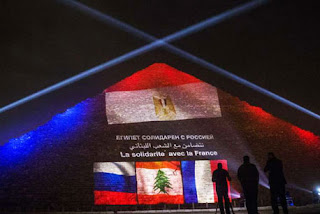
 Egypt’s Pyramids Light Up With Flags of France, Lebanon and Russia
The appalling attacks on Paris and Beirut just a few days ago have spawned a lot of comment over the internet, some of it constructive, a lot less so.

Personally I  am struck by the essential similarity between a massacre delivered on the ground and one delivered from the sky.

Maybe a fundamental question raised by such events is the old one about what such actions tell us about God, and about mankind.

It's a fundamental starting point to Christianity that people were created in God's image but that this image has become distorted and spoiled. In other words people are a strange mixture of good and evil, right and wrong, light and darkness.

So the basic question in Christianity is not why God allows things like these brutal massacres to happen, but what is he doing about them?

One answer lies in the bravery and selflessness shown by many in response to the horror around them - I am sure that in both Paris and Beirut there were far more people of courage and compassion than there were killers with their hatred and destruction.

But underlying that is a long term transformation of humanity: a preparation for a final cleansing which will bring healing and new life to a struggling world. The key enabling moment in that transformation was the death and resurrection of Jesus.

But that was nearly two thousand years ago! I trust that there is good reason for the long wait for Jesus' return and the transformation of heaven, earth and humanity that he will bring. Nevertheless, with the prophets of old, at times like this I have to ask:
"How long, O Lord?" 

PS: Clicking on the above image - a pyramid in Giza lit up with the flags of Russia, Lebanon and France - takes you to an extremely depressing list of terrorist attacks so far in 2015. One thing I do notice is that the vast majority are carried out by adherents of one particular extreme sect of Islam against members of more mainstream groupings within Islam - especially against Shia. Blaming Muslims in general for these attacks is about as accurate as blaming Christians for the actions of Westborough Baptist Church; although Wahhabist Salafists do get a lot more funding, thanks to Saudi oil money.

Wednesday, 4 November 2015

TED Talks & Preacher Training


I wonder if Bible Colleges and other theological training centres use TED talks as part of their training in preaching?

A talk with a serious message given by one person with minimal staging and taking less than 20 minutes - for churchgoers among you, does that sound familiar? If I add that the vast majority of TED talks closely engage both the immediate audience and, in many cases, millions of people worldwide then maybe the familiarity decreases.

I've been known to say that the traditional lecture-style sermon is way out-of-date and an appalling way of attempting to engage with modern people in the modern world. There is an elderly and declining population of churchgoers who often like them like that, of course, but I have long argued that a new approach is needed.

In many ways I still believe that: sitting passively consuming the words of a supposed expert is a lousy way to learn. Yet the global success of TED talks does suggest that there is life in the format yet, so I think it's worth looking at some of the typical characteristics of a TED talk.

Pretty much all TED talks are given by people with genuine and obvious enthusiasm and expertise who are speaking about something which they believe matters.

The vast majority have a speaker who moves around the stage, rather than being trapped behind a lectern.

Many TED talks involve some sort of projection/PowerPoint accompaniment, used as a visual backup and complement to the talk itself; whilst the talk remains the main focus.

Many of the talks involve humour - but rarely in the form of isolated jokes, more as ways of making or supporting a particular point.

Some of the talks involve some degree of interaction with the audience, but this is nearly always limited. People want to listen to the speaker and there is a tight timescale.

So I would say it is time for preachers to rethink their methods, congregations to rethink what they ask of their preachers, and occasional visitors to church to give more feedback on how they experience the preaching in that church.

If a preacher doesn't have expertise and enthusiasm then why on earth are they there? If the preacher doesn't make the effort to engage with the congregation through movement, interaction, relevant visuals and/or humour then why should they expect the congregation to engage with them? And if a preacher isn't talking about something which has meaning and importance to listeners and to their neighbours then why is s/he wasting everyone's time?

What do you think?