Showing posts with label religion. Show all posts

Wednesday, 6 April 2016

The Only Way?

But what does that mean?
Caversham Baptist Church have just started a sermon series looking at 'questions people ask'. I'm all in favour of that: I think questions are really important, not just for their answers but for the underlying attitude.

They have started with an interesting one too, with follow-up at their housegroups. I don't remember the exact wording of the latter, but it was along the lines of "How would you answer someone who thinks it is arrogant to claim that Jesus is the only way to God?" 

Good question, and a tricky one to deal with from a church background.

I'll just throw a couple of quotes from John's telling of the Gospel into the pot, so you can see where church people are coming from:
Jesus said to them, ‘Very truly, I tell you, I am the gate for the sheep. All who came before me are thieves and bandits; but the sheep did not listen to them. I am the gate. Whoever enters by me will be saved, and will come in and go out and find pasture. The thief comes only to steal and kill and destroy. I came that they may have life, and have it abundantly. (John 10:7-10)
Jesus said to him, “I am the way, and the truth, and the life. No one comes to the Father except through me." (John 14:6)
There's quite a lot of context around these quotes which maybe muddies the waters a little, but it is easy enough, I think, to see why those who believe in the Bible consider Jesus to be the only way to God.

But what does that mean?

What does a non-churchgoer understand by that phrase, what does a churchgoer think it means, and - most importantly - what did Jesus actually mean by it?

I'd guess the non-churchgoer interpretation is obvious: it's a claim that "my religion's right and all the others are wrong".

I'd also guess a lot of churchgoers would, when forced to clarify what they really mean, come up with something similar. The one that used to irritate me with its obtuseness was the idea that it must be right "because the Bible says so". Our holy writings say we are right; oddly enough other religions' holy writings tend to reckon they are right. You're not going to convince someone who doesn't already believe with that, not in this day and age, I'd have thought.

Actually it's a big jump from what the Bible says to 'other religions are wrong' anyway. Both excerpts are in a purely Jewish context, other religions are not mentioned. The context of the first is about true and false teachers, true and false shepherds, and the second is part of a rather obscure passage about Jesus' death and return and the coming of the Holy Spirit, including the repeated claim "I am in the Father and the Father is in me".

Christians believe that through his birth, death and resurrection Jesus paid the price to save mankind. I think it would be difficult to look at the child abuse, violence and corruption in the world and not feel that mankind needed changing, whether you call that 'transformation' or 'rescue'. And I also think that when you look at the compassion, heroism and beauty which people can also produce one must surely feel that mankind is definitely worth saving.

The question then is how we become part of that transformation. Is it by joining a particular religion, or some other way? John 14 suggests that Jesus will come to take his people to God and John 10 talks about his 'sheep' recognising and following his voice. Again, are those people chosen according to their religion, or by whether they trust and follow the Good Shepherd when they hear his voice.

I have a personal interest in this, due to my own experience some 38 years ago, when I was an atheist. I had no religion, yet I had an experience in which, whilst I didn't hear a physical voice, I did feel a clear message that told me that I could be a part of God's people, God's family, by turning my beliefs around and following Jesus. I did and my life followed a different path. That incidentally is what 'repentance', from the Hebrew Teshuva, means.

I didn't come to the Father because of my religion, because I didn't have one. I didn't come because I believed in the Bible, I didn't. I simply came because I heard the voice calling me and I responded. Anyone can do the same, whatever your religion or your lack of religion. When the voice of God calls you, simply respond and follow where it leads. You may be surprised.

Friday, 29 January 2016

Who Are The People Of God?

Jesus was a Jew: he worshipped at the Jerusalem Temple, followed Torah, the Jewish 'Law', even taught Torah - although with a subversive twist.

Jesus' earliest followers were Jews too, worshipping at the Jerusalem Temple, and so on.

Religious 1st-Century Jews knew who the people of God were: they were.

The people of God, they were sure, were born Jews (technically Israelites, although they denied the Samaritans that status), who remained within the covenant between God and Israel: the Torah. It was possible, although difficult, for a non-Jew to convert to Judaism and so become one of God's people too.

Torah includes provision for people who break its rules in a minor way to make a sacrifice and so return to compliance. By Jesus time this was taken to mean that you stopped doing whatever the infringement was. So if you stole, made the required sacrifice, and stopped stealing you were okay; if you continued stealing the sacrifice was not effective. This also meant that people who worked for non-Jews, who would necessarily break the food rules, were excluded from God's people unless they gave up their jobs.

A lot of the time when the New Testament refers to 'sinners' it means those who are outside God's covenant, maybe because they were born 'Gentile sinners' or because their lives exclude them from Torah. Correspondingly when it refers to those who are 'righteous' it usually means those within God's covenant. Thus you get one of the great letter-writer Paul's themes: those who are within Jesus are no longer 'sinners' but 'righteous' (or 'justified' or various other images of the same thing).

The sign of being one of God's people, from way back in the days of Abraham, had been to be circumcised (which maybe says something about the status of women!).

The very early church was essentially Jewish, although from quite early on they accepted Samaritans and even a eunuch (excluded from the people by Torah, but the prophets spoke of their acceptance when the Messiah came). Eventually even foreigners ('Gentiles') were accepted, although in Jerusalem and Judea they were very much in the minority.

Basically, in the first ten to fifteen years after Jesus' death and resurrection, the congregations of his followers nearly all shared a common religious upbringing and culture. It was very hard to separate that culture from their identity as God's people.

Then came Antioch. The church there started off as Jewish as anywhere else, but then they began attracting non-Jews to their meetings who wanted to join the church. When 'head office' in Jerusalem heard, they sent Barnabas to help - known as a good 'people person'. Barnabas went off to Tarsus to pick up Paul, who had previously persecuted Christians but, having met the risen Jesus for himself, was now spreading the word he had previously tried to suppress.

Barnabas and Paul built up the church in Antioch as a mixed church: Jews and non-Jews alike. But that meant that the congregation no longer shared that common religious upbringing and culture, nor even that 'badge' of God's people: a circumcised penis. Inevitably, perhaps, arguments broke out as religious expectations were not met and assumed standards of behaviour were ignored.

How are the people of God meant to live? Once outsiders have been welcomed in, is it the expectation that they will then change to become just like the insiders?

In the early church one big question was whether those who came into the faith, who had joined God's people later in life, should adopt the badge of God's people and become circumcised. The Old Testament (as we call it today) scriptures were clear: God calls his people to be circumcised. Slightly less clearly, the assumption (of those who grew up religious) was also that God calls his people to follow his law: the Torah.

Paul strongly disagreed: for him the 'badge' of God's people was the Holy Spirit (whatever he meant by that - a subject for a future post) and the 'law' that they had to follow was the law of love, guided by that Holy Spirit.

This row came to a head after Paul and Barnabas returned from travelling through Southern Galatia founding new mixed congregations, where Jews and non-Jews worshipped together.

But the question for churches in Britain today is: how do we deal with an influx of those who do not share our upbringing and religious values? For many, maybe most, of us this influx is something we desperately need, but the experience of Antioch and Galatia long ago warns us that it will not be easy. We insiders will have to change our ways: ditching a lot of cultural baggage, even when that baggage seems justified by tradition and scripture.

Somehow we must rediscover Paul's vision of the diverse people of God, gathered together in local communities, following Jesus under the guidance of his Spirit. After nearly two millenia that is quite a challenge, but it is necessary if we are to be faithful citizens of God's Kingdom.

Grace and peace for your week ahead.

Wednesday, 16 December 2015

Sacred Cows

Sacred cow: Something too highly regarded to be open to criticism or curtailment.

Lots of us find change in our lives to be an uncomfortable process for all sorts of reasons, both practical and abstract. Change is especially difficult when it challenges core assumptions which we may not even have realised were there.

The same discomfort, but magnified, tends to face churches as we recognise our need for change. St John's Church has been wrestling with it for a few years now, and we're coming to recognise that our pace of change needs to increase dramatically into the near future.

Our Rector, who specialises in interesting questions, asked a few weeks ago what the 'sacred cows' were here: what is there which is sacrosanct for us - not open to change at all.

The trouble with initial responses to a question like that, at least for me, is that I tend to think of other people's sacred cows: the pulpit which is never used - long made obsolete by a sound system and a change to the old patriarchal culture - but which we can't get rid of, or even move; or archaic language used in prayer - often taken to mean the exact opposite of what was meant originally. I'm happy to lose their sacred cows, but I wasn't even sure I had any.

Later I did some more thinking. We definitely need to change and grow, but what would be too high a price?

As a parish we say that our core values are being 'inclusive, generous and life-giving'. At St John's we try to focus those values around being welcoming: as a church community we aim to offer a welcome which is open, inclusive, generous and life-giving. Somewhere in that lie my sacred cows.

Over the river is a large Anglican church, one of whose senior members has a reputation for being very unwelcoming toward same-sex couples: they hit the front page of the local paper on the issue some years back. If that church offered us a group led by this senior member to help us grow, I would take a lot of convincing.

Similarly there are a number of religious groups around Reading, many following a charismatic tradition, who are virulently anti-Muslim. I don't see how partnership with such groups could possibly work.

Now, I need to be careful here. Being unwelcoming to those with reservations about same-sex relationships, say, is also neither inclusive nor open. But there is a difference between following one's conscience in one's own life and trying to use your values to exclude or to manipulate the behaviour of others. As the saying goes: "If you don't believe in gay marriage then don't marry a gay person."

There is a question of integrity, of being true to the Christian values we proclaim. There is also, for me, a fundamental question around what it is which is distinctive about the faith proclaimed in the pages of the New Testament, particularly by Jesus himself.

My reading is that Jesus offered openness and genuine welcome to those excluded by the religious groups of his day. I am in the middle of a little book by Rowan Williams on Paul, looking why what he said was so revolutionary, then and now. Again the answer lies around inclusion not exclusion, welcome not rejection, removing barriers not building them.

In my view any attempt to build up St John's numbers by building walls, by scorning and excluding others, and by emphasising our own holiness and distinctiveness, may or may not help with numbers and dedication, but it would be building up something which is non-Christian, or at best sub-Christian.

Herod's Temple was characterised by its high walls and by its levels of exclusion: a building whose purpose was meant to be bringing people close to God in worship became a place dedicated to separating people from God. When Jesus died on the cross, we are told that the curtain in that Temple, the curtain which separated off the 'Holy of Holies', God's dwelling place, was torn in two, from top to bottom, opening the way to God for all.

Following Jesus is about enabling people to meet God for themselves - all sorts of people, irrespective of gender, social class, race, religious upbringing, relationships, scientific literacy, doubts and certainties. All are welcome to 'taste and see' in their own way; our job is to welcome them and to share what we have found to be life-affirming.

That's my sacred cow. What about you?

Sunday, 22 March 2015

Fathomless Riches by Richard Coles

Richard Coles' account of his journey from pop stardom with the Communards, and left-wing gay activism, to priesthood is fascinating and highly readable, although it ends rather abruptly, I feel.

One of the fascinations of the book is Coles' sideways take on religion and what is important. At one stage he says:
"I realised, too, that I was one of very few people in the Church of England to have gone to a Solemn High Mass at St Alban's Holborn and there experienced a classic Protestant conversion."
In many ways the book is like the classic Protestant conversion story: "I was the wickedest of sinners but now I'm saved!" Except that the standard Evangelical tale is of salvation from drink, drugs, women, crime, whatever. Coles tells of plenty of drugs and sex (gay), but that isn't his repentance story. His story is about being saved from self-centredness and hardness of heart. It's about treating people in an appalling way and coming to regret it. That is the sin from which he has been saved by Jesus:
"And then it was as if iron bands, constricting my chest, broke and fell away and I could breathe; and a shutter was flung open, and light flooded in and I could see. And I wept and wept."
For Coles it is people and how you treat them which matters, not issues of sexual morality.

A few months ago Richard Coles and Tim Minchin wrote a pair of articles for The Big Issue about faith and Christianity. Coles' article was about people and read as a simple and heartfelt call for care and respect, which he saw religion, at its best, as being able to provide. Minchin's article, on the other hand, was about ideas and read as bright and shiny and clever ... and ultimately shallow.

The other fascinating element of the book, for me, was his insider's view of the gay, left-wing activism of the late seventies and eighties. This overlaps with a film recently out on DVD, Pride, which tells of the unlikely alliance between miners and gay activists during the Thatcher-provoked miners' strike of 1984-5. I haven't seen that film yet, although I plan to, but Coles references it as he talks about LGSM - Lesbians and Gays Support the Miners - and the unlikely cross-cultural bonds they formed with the South Wales mining communities.

There is also a lot in the book about The Communards, of course, Coles' and Jimmy Somerville's highly successful, but short-lived, pop partnership. Interesting, because well told, but not really my preferred style of music, to say the least.

There is also a fair amount about the process of actually becoming a priest, then the book suddenly halts directly after his ordination. Nothing about being a priest, nor about how his calling and his sexuality work together. Maybe he is thinking about a volume 2, or maybe he just wanted the book to do what it says on the cover: How I Went From Pop To Pulpit.

Either way his penultimate paragraph is wonderfully evocative of what the Church of England is and how it works:
"I looked into people's faces, faces that had seen me at my best and my worst, at my most vulnerable and my most triumphant, at my sleaziest and my finest, and we went to the church hall for tea and cakes and speeches and presents and I ducked out for a moment and went into church, the new curate on his new patch, for the first time."

Monday, 6 October 2014

Whose Image?

Then the Pharisees met together to plot how to trap Jesus into saying something for which he could be arrested. They sent some of their disciples, along with the supporters of Herod, to meet with him. “Teacher,” they said, “we know how honest you are. You teach the way of God truthfully. You are impartial and don’t play favourites. Now tell us what you think about this: Is it right to pay taxes to Caesar or not?”

But Jesus knew their evil motives. “You hypocrites!” he said. “Why are you trying to trap me? Here, show me the coin used for the tax.”

When they handed him a Roman coin, he asked, “Whose picture and title are stamped on it?”

“Caesar’s,” they replied.

“Well, then,” he said, “give to Caesar what belongs to Caesar, and give to God what belongs to God.”
His reply amazed them, and they went away.

I don't know about other countries, but here in the UK all our money - coin and paper - has the queen's head on it; how little has changed in two millennia. But it makes the first of Jesus' points clearer: pay your taxes, don't cheat the government. The government prints the money and, these days, it gives it its value, so give to the government what is theirs. No tax evasion, no tax avoidance: the mean-spiritedness which pays accountants and advisors in order to avoid paying the government just shrivels the soul.

But that part of Jesus' reply is not what amazed his questioners and sent them away silenced.

"Give to God what is God's" - if money bears the Caesar's image, what bears the image of God? Or, more precisely, who? Way back in the very first chapter of the Bible, we are told "God created mankind in his own image. In the image of God he created them; male and female he created them". You and I bear God's picture, his image ... maybe somewhat messed up, but there nevertheless.

"Give to God what is God's" - that would be myself, and my neighbours. Jesus said elsewhere that we cannot serve both God and Mammon - money, wealth, possessions. Money is useful to live, and has its own rules, including payment of taxes due. But God takes priority over money.

Part of the background to the question was that people were struggling to pay both the Roman taxes and the taxes and tithes demanded by the religious authorities. Part of Jesus' answer is that these religious authorities - and the questioners - were wrong to be focussing on money as they did. Their focus should have been righteousness and justice - which would have messed up their cosy relationship with the Roman occupiers, of course.

The standard Anglican communion service has a quite remarkable line toward the end:
Through him [Jesus] we offer you our souls and bodies to be a living sacrifice.
Which is an amazing sentence, when you think about it, but it does take Jesus' 'Give to God' point very seriously.

Money is useful for living, but God must come first: his justice and his mercy. And how we spend our money (after taxes) reflects our priorities. Whether that is in spending a few extra pence on 'fairly traded' food (or not), or buying more expensive (in the short term) low-power light bulbs (or not), or reducing our use of our car - if we have one - in favour of walking, cycling or public transport (or not).

We are made in God's image; so are African farmers struggling against unfair global terms of trade; and so are Bangladeshi's at risk of being flooded out as sea levels rise due to global warming.

Giving to God what is God's means being careful of God's image, wherever it occurs, and acting in ways which benefit that image throughout the world.

"Do justice, love mercy, and walk humbly with your God."

Friday, 20 June 2014

Why War?

http://pixdaus.com/flanders-poppy-field/items/view/79467/
We are heading toward the centenary of the beginning of the First World War, a particular lowlight in a century marked by war and massacre.

Looking back at the violence of the 20th century, it strikes me how much of it was characterised by a toxic mix of nationalism and ideology, and how little it had to do with religion.

The First World War was fairly unambiguously nationalist and imperialist in origin, whilst the second seems to have been triggered by a more complex brew. On the one hand there was German national feeling, battered after WW1 and bearing grudges over the post-war loss of Germanic territories; on the other there was fear of communism, fear and hatred for 'the other' - particularly, but not exclusively, 'The Jew' - then there was a striving for discipline and order, represented by a powerful fascist ideology, and a bizarre mix of Aryan and Wagnerian mythologies.

Meanwhile, in the Far East, causes seem to have been more simply about nationalism and access to resources (traditionally the other main driver of imperialism).

In between these 'world wars' you had the Bolshevik takeover in Russia, with its ideological civil war followed by mass famine as their policy of Prodrazvyorstka destroyed the battered agricultural system; then under Stalin the famines and purges continued as ideology and tyranny ran their course.

After the Second World War, the Cold War marked the continuation of ideological and imperial conflict, much of it through proxy wars in Korea and Vietnam. Meanwhile the Maoist revolution in China followed the path of Russia's revolution through civil war, mass famine and extensive purges.

I am only aware of two major outbreaks of violence during the century where religion was one of the main causes, both in the late '40s: the Partition of India in 1947 and the founding of Israel in 1948. Both of these events had violent repercussions which continue to this day, and both had a strong religious element. Both also had a strong ethnic and nationalist element: religion and nationalism can be just as toxic a compound as ideology and nationalism, it seems.

There is a list of 20th-century battles on Wikipedia, which gives an idea of the continuous level of conflict during that troubled century.

Granted that my knowledge of 20th-century history is not exhaustive, I do still find it strange that the 'new atheists' - the likes of Richard Dawkins - continue to link war with religion. With a couple of exceptions, here was a whole century of essentially non-religious violence, much of it explicitly atheist.

Why war? Because people are prejudiced; often they are ignorant and demonise 'others'; they are all too ready to follow leaders who tell them they are right and others are wrong; and because, by and large, people prefer to function as part of a local ethnic/racial community, rather than as part of worldwide humanity.

Most religions attempt to work to a bigger picture, which could be immensely helpful in enabling people to live together in peace. Sadly, all religions are composed of fallible, flawed people, as are all ideological groupings. We could just wait for God to fix it, or we could try to work with God and spread peace and justice in our own small ways, wherever we are, and whoever we are with. It's our choice.

Postscript: There is an interesting post on a similar theme over on the BeThinking blog.


Sunday, 2 March 2014

Church Going?

http://www.stpetercaversham.org.uk/
Not Church ... just a building
I was not brought up in church: my parents were not churchgoers. I was brought up agnostic, which hardened to atheism in my teens, and I only came to faith after I was 21.

In Caversham churches, at least, this seems to be very much a minority position. Most churchgoers here seem to have grown up going to church. Likewise, these days, most non-churchgoers have never regularly been to church, and have had little exposure to church culture.

It makes a difference. I’ve been actively involved in churches for more than 30 years now, but I still find a lot of what goes on there alien and alienating. The somewhat separatist culture, the fixation on rules, what John Pritchard, Bishop of Oxford, calls the ‘sacred-secular divide’ – the idea that what goes on inside church buildings and church structures is, somehow, more special to God than what goes on outside. Then there’s the weird time-warps: 19th-century, 17th-century, medieval – some of it can convey a rootedness in worshipping history, but most of it is little more than anachronistic escapism, it seems to me.

Not to mention the way many churches obsess about sex and about controlling people’s private lives (not so much at St John’s, where I now worship, to be fair, but definitely at other Caversham churches), very much contrary to Jesus’ own attitudes. In fact that’s an important issue: the rather obvious gap between the words, attitudes and actions of Jesus, on the one hand, and the words, attitudes and actions of those who claim to follow him, on the other.

So, when people say – as they do – that they are spiritual but not religious, I can see where they are coming from. When people say they admire and respect Jesus, but are not interested in institutional religion, I can relate to that. And when people say that you don’t have to go to church to be a Christian, it is undeniably true – a basic knowledge of British church history covers that, albeit with a twist.

And yet ... and yet ... it is also true that from the beginning, following Jesus was something to be done in company, in a supportive community of fellow-followers. A mixture of very different people, sharing joys and sorrows. The blind supporting the lame, whilst the lame guides the blind. People who can bring God’s comfort when God Himself seems far off – he’s not, but when life gives us a kicking then He can seem that way. A hand, a kindly word, a listening ear ... in some US churches there is a tradition of taking food around to someone who is going through a rough time: practical, kindly and comforting. Also, the reality is that we are here to make a difference, and that is so much easier when we work together, rather than alone.

So, yes it is true that you don’t have to be part of a church to follow Jesus – I know people who do just that; but they are better, stronger men and women than I. But when it comes to Christian community, like it or not, institutional churches are the only show in town ... at least here in Caversham.

Saturday, 15 February 2014

A Short History Of (My) Blogging

Two posts in the last six months - not really the way to build a blog.

I was looking back recently at some of my earliest blog posts from Christmas 2005. Back then the plan was to post weekly, at least, and to link topics of general interest across to questions of faith. Easy for Christmas, of course, but there were also posts about films and music - I even had a post (written by someone else) about a Coronation Street storyline. Back then I was website editor for a church website, and the hope was that such a blog - running in parallel with the church magazine - would attract visitors and interest from a wider range of people than simply those searching for "baptist church in Caversham". Which it did.

Unfortunately, what it didn't attract was posts from other church members - the one linked above was the only one I got. Also, we lost the church magazine: mostly because the new pastor - although, IMO, definitely a good guy - tended to preach very legalistically and obsess about sex, which drove away our magazine editor. So when said pastor - who was also very pro-Israeli - tried to censor the blog for not being sufficiently pro-Israel (the offending article is here), I decided I was getting nowhere and resigned as website editor, so the blog became standalone. You can see my thoughts at the time in the series of three posts from here.

So "Webitorial Ramblings" became "BlackPhi's Website Ramblings", and the posts carried on - still more than weekly, and still based around news, culture, and Caversham life, plus a bit of what was going on in church. A month or two later, a great guy named Jonathan Jones kindly invited me over to Blog City, which (back then) was a blogging community - with interaction and feedback, and real live comments! So I started blogging there in parallel, see here for my first Blog-City post, complete with kindly words from JJ.

Both blogs seemed to have their own readership, and transferring posts between them helped with proof-reading, so I ran them in parallel for more than two years - I can't easily count the number of posts in that time, but I'm sure it was comfortably over weekly. One of the final few posts on my standalone blog was one I found amusing about the dangers of DHMO - a widely used industrial chemical which is reported to cause over 400 deaths a year in the UK alone. Late in 2008 we moved house, and I retired the PC I had been using as a web server, so I decided it was time to retire the standalone blog also.

Blog City continued; during 2009 posts thinned out a bit but remained not too far off the weekly post average (although much more erratic in distribution, eg 7 posts in Sept 2009, 2 in October). Looking back there seem to be a lot of music-themed posts in this period, eg here and here. Posts picked up during 2010, although the feel of them seems heavier to me now, having just reread the earlier 2005/6 ones. Maybe I was just older and wearier, or maybe there wasn't so much to say. Certainly Caversham Baptist Church was becoming more of a drag and a drain, which can't have helped. There were great people there, but as a church it was (IMHO of course) losing the plot.

Then Blog City closed down. We had plenty of notice, but it was still really sad - like an established neighbourhood being demolished. I started up a new blog here on BlogSpot, but it really isn't the same: if there is a BlogSpot community I still haven't managed to tap into it. The first post got several comments, but only from BC friends, otherwise it seems to be only techie posts that get much response here, most notably one on Trusteer Rapport problems.

Posts dropped to fortnightly on average in 2011, slightly better in 2012, then less than monthly in 2013. Post lengths have crept up, and content seems to me to be getting more religious. At the end of 2012 I left Caversham Baptist Church - a painful decision but necessary, I felt. Maybe post frequency has dropped off because I'm not so angry? Or, more likely, because the final few years at CBC left me feeling very jaded and disillusioned - it's one thing to hear about churches which turn away from God, quite another to be in the middle of that. It's especially bewildering to see that the individuals involved remain Godly, whilst the 'church' community loses its direction, and stops following Jesus.

So here I am in 2014, with another post which is too long. I think it's time for another rethink, before I give up on the blog. Maybe it's time to reverse direction: the old theory was to start from the news, culture, Caversham life and seek Jesus there; maybe it is time to try working from the inside out, to start from religion and see if I can find some way to relate that to the real world. It'll certainly be a challenge!

Wednesday, 1 May 2013

Christianity Is ...


Christianity is about following Jesus,
not about believing doctrines and following rules,
certainly not about joining an organisation.

Following Jesus can start from the smallest foundation,
depending on Grace, then setting out
on an unknown journey.

Christians meet together to share that journey,
to share the burdens and celebrate the joys,
supporting and encouraging one another
along the way:

in coffee shops, in homes, in pubs,
sometimes even in church buildings,
always with Jesus.

God is changing the world,
fixing the mess;
we can be part of that,
if we so choose.

Christianity Is.


Sunday, 30 December 2012

Out With The Old

It's a rather sad end to 2012, as I have resigned my membership of Caversham Baptist Church, where I have been a member for almost seventeen years.

The new(-ish) pastor at CBC, who is a little inclined to say strange things without thinking them through, reckons that being a member of a local church is like being in a marriage. As a pastor he must have been a member of some four or five churches over the past twenty years - I wonder if his wife realises how casually he views marriage? I view being a church member more like living in a house: moving house is a painful experience, but sometimes the old house is just not suitable. It is following Jesus which is the lifelong commitment, like marriage; where one is based can help or hinder, but it is not the main thing.

Why have I resigned from CBC after all these years? Basically because seventeen years ago Caversham Baptist was a church I admired and was proud to become a member of; and because back then I found it a really good place to worship God with my fellow Christians and to seek to work together for God's Kingdom here in Caversham. Neither of these things is now the case: there are some lovely people at CBC, but as a church it has lost its way; and as a place to worship it no longer does anything at all for me.

There is a classic alternative approach, which is to hunker down and outlast a lousy 'minister': "I've been here x years/all my life, I'm not going to allow some johnny-come-lately to drive me out." This is a fair enough approach, especially for those who have grown up in a church, or who are getting on in years, but it does ignore the question of what sort of state the church will be in by the time the duff 'minister' leaves. It also treats a church as more of a club to belong to, rather than a working organisation which is tasked with actually achieving something. Better would be to work together to actually change things, but passive deference is a hard habit to break.

Really, though, CBC has been moving away from its roots for longer than the new pastor has been here; indeed the whole process of 'calling' him (the procedure a Baptist church goes through to - in theory - seek God's will for its new minister) was severely tainted. The church direction and organisation have been becoming more top-down and centralised, and less member-driven (the Baptist theory is that Jesus' will is best discerned through his many followers within a church rather than just a single individual 'minister' or small group of 'leaders'), for many years. Focussing out, into the local community, has long been a talked-about aspiration: lots of preparation, not much action. To be fair, during the 'interregnum' - between pastors - there were some encouraging steps made towards this, but these were quickly killed off by the new boss.

For me, preaching is at the heart of Baptist worship; it used to be the one thing they did really well. But even this has, for several years, been drifting further and further away from teaching Scripture and proclaiming Jesus, to be more and more about highlighting the preacher and his traditions and opinions. Granted the new guy has taken this to a new low, but the CBC congregation has happily accepted substandard fare for far too long (remembering that Baptists, in theory, are very Bible-centred).

So, where now? Another disillusioned ex-churchgoer worshipping Jesus in daily life, but without an established Christian community behind me? I hope not: many, many people take that approach, but I am too aware of my own limitations to think that is an effective way for me to live and serve. Obviously there are no perfect churches, in Caversham or elsewhere; for now I'll worship freely and see where I find a calling.

Footnote: I can't help feeling that my final post of 2012 (not my favourite year, in truth), and my only post for December, ought to have more shape and more point than this. But I guess that's where I am at the moment: lacking in shape and clear point. Nevertheless, 2013 is another year, and God always has something new to say; the trick is to be in a place where one can hear Him and respond.

A happy and blessed New Year to any and all who read this.

Wednesday, 28 March 2012

Churches Against Jesus

It is depressing when a church takes a stand against Jesus, against the Bible, and against common courtesy and hospitality. Yet that is exactly what Caversham Baptist Church did a couple of Sundays ago.

The Bible tells a story of Jesus going to have dinner with a guy named Simon, an important religious man. While Jesus was there a 'sinful woman' comes along and washes and anoints his feet. Simon sneers at her, and by association at Jesus. So whose side does Jesus take: the righteous Bible-believing man, in his position of strength, or the sinful woman, in her position of weakness? Jesus, of course, sides with the weaker, with the sinful, scorned woman. He does this a lot in the Gospels: sides with the bullied against the bullies, and with the scorned against the proud.

I was reminded of this story the Sunday before last, when someone plugged an anti-gay petition at the end of the morning service at Caversham Baptist Church. The petition is from a group calling itself C4M, Campaign for Marriage, and says "I support the legal definition of marriage which is the voluntary union for life of one man and one woman to the exclusion of all others. I oppose any attempt to redefine it."

It sounds fairly innocuous, except for the context that the government is currently considering whether to legalise 'gay marriage'. So this looks like a petition aimed at homosexuality; this is confirmed by looking more deeply at C4M. Their website is rather reticent about their background, but a few seconds googling shows that they are controlled by a group calling themselves 'The Christian Institute', an anti-gay pressure group.


In the UK (and around the world) homophobic hate crime is on the rise, it seems, whilst suicides as a result of homophobic bullying continue to be reported. Yet some churches still ignore this reality, and continue to condone, even encourage, such behaviour by their continued attacks on homosexuality, on gay people, and on equal rights for all, regardless of sexuality. Too many churches are standing with the bullies; Jesus, as ever, stands with the bullied. Caversham Baptist Church, amongst too many other so-called 'evangelical' churches, stands against Jesus.

It's not even as if the petition is Biblical: the Bible clearly contradicts such a restrictive definition of marriage. Actually Scripture nowhere provides a clear definition of what marriage is, although with a bit of reading between the lines one can combine part of chapter 19 of Matthew's Gospel with part of Genesis chapter 1 to deduce that in the beginning, before the Fall, the plan was that a man and a woman should be united into 'one flesh'. After the Fall, when people's 'hearts are hard', there is more flexibility and other arrangements can be recognised as 'marriage' - see the divorce rules in Deuteronomy, for example, and the sad story of Jacob, Leah and Rachel. These arrangements may not be recommended by the Bible, but they are recognised. The petition, in seeking to restrict legal recognition of marriage, goes way beyond the Bible, in a way that is directly contradicted by the Scriptures.

Finally, consider what it would have been like for a gay visitor to Caversham Baptist Church that morning. To hear songs and sermon about God's grace and care then, like a slap in the face, to hear that many (most) of the churchgoers there support gay-bashing and oppose gay people having equal rights under civil law. What sort of hospitality is that? What sort of witness?

Irrespective of what people think the Bible says about homosexuality, irrespective of their prejudices about what civil marriage is about, I find it deeply disturbing that a church body can think it appropriate to promote a petition like this, and even more disturbing that so many of the churchgoers actually signed it. It is no wonder that the church is becoming increasingly marginalised in the UK, and increasingly seen as a social club for the intolerant.

How did we come to this; how did the Pharisees win?

Tuesday, 27 March 2012

Why I Think Rowan Williams Is A Good Guy

(Part of the reason anyway).

Lulu, the six-year-old daughter of journalist Alex Renton (who doesn't believe in God), wrote God a letter:
To God how did you get invented? From Lulu xo
After some thought (you can read the full story here), he sent a copy of the letter to a number of people, including the head of theology of the Anglican Communion, based at Lambeth Palace. After a while a reply came from Rowan Williams himself:
Dear Lulu,
Your dad has sent on your letter and asked if I have any answers. It's a difficult one! But I think God might reply a bit like this –
'Dear Lulu – Nobody invented me – but lots of people discovered me and were quite surprised. They discovered me when they looked round at the world and thought it was really beautiful or really mysterious and wondered where it came from. They discovered me when they were very very quiet on their own and felt a sort of peace and love they hadn't expected.
Then they invented ideas about me – some of them sensible and some of them not very sensible. From time to time I sent them some hints – specially in the life of Jesus – to help them get closer to what I'm really like.
But there was nothing and nobody around before me to invent me. Rather like somebody who writes a story in a book, I started making up the story of the world and eventually invented human beings like you who could ask me awkward questions!'
And then he'd send you lots of love and sign off.
I know he doesn't usually write letters, so I have to do the best I can on his behalf.
Lots of love from me too.
+Archbishop Rowan
The letter went down well with Lulu, we are told, especially the idea of "God's story". But best of all is Lulu's response when her dad asked her what she thought:
Well, I have very different ideas. But he has a good one.
 I'm sure the archbishop would approve.

Friday, 9 March 2012

Prayer & Change

I reckon you could call prayer without action 'empty religion', action without prayer 'irreligion', and preparation, prayer and action working together 'changing the world'.

I see all three in churches, but recently there seems to be a lot of emphasis on the first 'empty religion' approach. Which is a pity, because the world is a long way from how it should be.

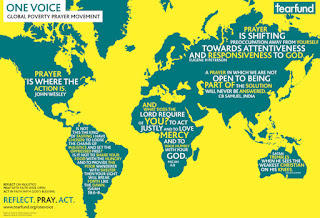
I've recently heard three rather different examples: a super talk by a young woman from TearFund (which is where the picture came from, click on it to see a larger, clearer version); a less super claim at a religious concert that 'my God is wealthy enough to deal with all your debts' (in a slightly grating Belfast accent); and the, at best ambivalent, suggestion shortly after Christmas that if your credit card is maxed out then 'take it to the Lord in prayer and stop worrying' (that one in a Yorkshire accent, as it happens).

In a previous recession I myself had a fairly serious credit card problem - the 'take money out of one card to make the minimum payment on the other' game. Burying one's head in the sand is a classic response to debt, so the suggestion that one can simply tell God about it then carry on ignoring the debt is really not a helpful one. On the other hand, talking to God about the problem and your worries then listening to what God says and acting on it - probably to DO something about the debt - and trusting Him enough to stop worrying whilst you act ... that's a different matter. So I call the suggestion 'ambivalent' because whilst the preacher may have meant the active latter, I strongly suspect many of his listeners heard the passive former.

It's not just 'doing' though: typically real, two-way, prayer results in change - change in attitude and change in approach. To forgive someone when they have really harmed us is incredibly difficult, and often takes a long time. But not forgiving continues to cause further harm. Prayer and change of heart go together: the journey may be long and hard but, in prayer, God is with you all the way.

Of the various quotes featured on TearFund's 'Reflect, Pray, Act' poster, my favourite is from CB Samuel: "A prayer in which we are not open to being part of the solution will never be answered". God is not our gofer  - He helps us, encourages us, supports us, wants us to grow and wants us to take responsibility for our actions. The Church is meant to be Jesus' hands and feet, heart and mouth.

The expectation in any prayer should be that God will respond and that we will be asked to take part: sometimes by waiting trustfully, sometimes by resting in the assurance of His love, sometimes by changing our attitudes, sometimes by saying something that needs to be said, often by changing our behaviour, often by getting our hands dirty. God will be with us throughout, and together we really can change the world for the better. "Your Kingdom come" and all that.

Thursday, 16 February 2012

True Religion

Religion that God our Father accepts as pure and faultless is this: to look after orphans and widows in their distress and to keep oneself from being polluted by the world.
James 1:27
Continuing from my last post, about Jefferson (aka Jeffrey) Bethke's Why I Hate Religion But Love Jesus poem/video: the above Bible verse makes it clear that God, and by implication Jesus, is not against all religious behaviour. This is no criticism of Bethke - his is a poem not a carefully balanced argument - but it should be a starting point in considering how to respond to that poem.

The other useful reference point would be clarity about what we mean by 'religion' anyway - something which all the responses I have seen manage to forget.

A key point to consider is why that poem resonates so widely. Those who have publicly responded to Bethke seem to miss this reality: 'religion' has become a very dirty word, not just among young churchgoers, but within much of non-churchgoing society. I see it in New Scientist, a scientific magazine (really!) which has become outspokenly anti-religion over the past decade or so, and I see it as a general trend within the liberal end of the media, in letters pages, and in comments across the internet.

In many ways I can see their point:-
  • The US religious right has spent the past twenty years becoming increasingly vocal and influential with their rhetoric: anti-education, anti-science, anti-healthcare, anti-environment, anti-gay and now anti-women.
  • The attack on the Twin Towers by religious/nationalistic extremists, followed by other atrocities around the world.
  • The Middle East: the wars in Iraq - presented as religious 'crusades' - and Israel's unopposed flouting of international laws and standards.
  • Roman Catholic child abuse scandals. Some blame religion for the child abuse (unfairly: child abuse happens at least as frequently in a non-religious context); others for the cover-ups and for allowing abusers to re-offend elsewhere.
  • The Anglican/Episcopalian church tearing itself apart over equality of treatment for women and homosexuals.
  • Intercommunal violence between groups with different religious affiliations: Northern Ireland, Bosnia, Nigeria, and so on.
  • General partisan bickering within 'Christianity': protestant against catholic, evangelical against liberal, Calvinist against Arminian, little-enders against big-enders, whatever.
Responses along the lines of 'our religion isn't like that' honestly don't help.

"What if I told you, Jesus came to abolish religion?" -  I'd reply that there is no evidence to support that in the Bible. Equally, there is no evidence that Jesus came to start yet another religion: the Bible tells us he came to save the world, surely much more important.

It's not really that "Jesus and religion are on opposite spectrums"; comparing Jesus and religion is like comparing apples and aadvarks: what Jesus did and what religion does are qualitatively different.

"One is the work of God one is a man made invention ... because religion says do, Jesus says done." These two phrases make an important point ... one which can as easily be positive as negative.

The Bible tells us that Jesus came to save the world, to rescue humanity, to bring an end to sin (injustice, abuse, intolerance, hatred, that sort of thing). We are given the opportunity to accept what Jesus has done and to become a part of God's Kingdom, citizens in the new world that God is preparing. We can become Jesus' followers, disciples, children of God, however you like to put it. But that is a beginning not an ending.

Accepting what Jesus has done for us through his death and resurrection is the beginning of a journey, not the end. If we have become followers of Jesus then we need to live as such. Jesus has saved us, now we need to live in that salvation. God has done, so we must do. As the apostle Paul wrote to the church at Ephesus:
For it is by grace you have been saved, through faith ... created in Christ Jesus to do good works, which God prepared in advance for us to do.
If religion is the doing, then religion is intended to be the way that Jesus' followers respond to God's grace. Religion is humanity's answer to God's mercy.

But humanity is fallen, we may be saved but we remain part of a world that has gone horribly astray. Some followers of Jesus take their eyes off him and miss the point; many others want to follow God but have never met him. We try to live out God's love together and it often goes wrong.

Religion is not binary true/false, bad/good. Religion is a spectrum, from more true to God's way to less true. It covers those who don't know Him and are trying to do their best in their own strength, through those who are desperate to be Jesus' disciples but don't really know how, and those who just want an excuse, a fig-leaf for their own hatreds and intolerance.

Religions support the poor and they encourage repression of the poor; religions promote love and they preach hatred; religions stand up for education for all, and they oppose teaching of truth. Religions can be a blessing or they can be a curse ... just like any other human activity.

Religion is not the real problem, fallen humanity is the problem. And for that Jesus is the solution.

Friday, 10 February 2012

Love Jesus, Hate Religion, Tickled By People

There's a poem by Jefferson Bethke, Why I Hate Religion But Love Jesus, gone viral on the internet in the past month. Especially amongst church teenage groups. Most of whom were brought up in church. What I would call 'religious kids'. You have to smile.


Also fun are some of the responses to the video. Religious people giving religious responses which mostly show that they just don't get it. You can see a good selection in a post on the Sojourners' God's Politics blog, Follow The Meme: lots of sincere people making lots of good points in defense of their religions.

I think one job of a poet is to make people think: Bethke has clearly succeeded in that. Another job is to move readers into seeing a different perspective, a bigger picture. The responses linked to above don't really seem to do that: they just stay defensively hunkered down in their old perspective. That's a shame. It's not Bethke's fault, it's just how these responders choose to react.

What Bethke's poem fails to do, in my view, is to help the opposite pole see a bigger picture. It challenges those inside the religious establishment to look beyond their walls, but I see no challenge to those outside the church to look inside: to see past the stereotypes, the media headlines, the loudmouth spokespeople, and to see the mostly-ordinary men and women trying to live out their faith together in the day-to-day realities of life.

Nick Mason, on his blog New Ways Forward, recently wrote an article about the need for us to define ourselves more by what we affirm and less by what we oppose:
Eventually we must break away from the pull of finding our identity in conflict and opposition, and be for something.

There will be things that need to be spoken out against from time to time, but perhaps it is more important, and more effective, if we spend our energy creating something beautiful, powerful, and transformative.
Eric Metaxas, at last week's US National Prayer Breakfast, gave a long (although entertaining) illustration of the positive side of the difference between religiosity and active faith that comes from the heart, using the examples of Wilberforce and Bonhoeffer.

There are around about a dozen churches here in Caversham, filled every Sunday with lovely people singing and praying to God. Meanwhile there are around about another thirty thousand people who are not doing this, and who don't see any meaning or relevance for such activities in their lives. The church-goers are focussed on their church, as an organisation, as a building, as a set of practices and behaviours which they find helpful, even life-giving; the church-abstainers wonder what they are on about.

What would Church look like if it was for the thirty thousand? How could Jesus be embodied in the lives and fellowship of those who need something more, or at least something different?

Saturday, 31 December 2011

You Who Pass Judgement

Crazy Judge by prthugp
It's probably the worst placed chapter boundary in the entire Bible: the one between chapters 1 and 2 of Paul's letter to the Romans. Of course, chapters and verses weren't part of the original Bible, they were added later for convenience. Convenient they undoubtedly are - I don't know the Bible off by heart, and I don't know anyone who does, so finding references without chapter and verse would be near impossible - but they also sometimes change or obscure the original meaning. Particularly as preachers and writers of Bible-study notes tend to lazily split their teaching by chapter rather than by content.

The problem in Romans is that Paul is using a clever rhetorical trick to make a point, and the chapter boundary cuts off the punchline from the lead-in. It's a trick used long before by the prophet Amos (cf Amos chapters 1 and 2): Amos starts by criticising Israel's neighbours, saying how wicked they are and how God will punish them. Then, when he has all his Israelite hearers nodding along, he turns on them, telling them that they are even worse, so shouldn't God punish them even more.

In the second half of Romans 1, Paul has what looks like the most amazing rant against 'all the godlessness and wickedness of people': "they are without excuse," he thunders. Then you get the chapter boundary. If you stop there you are left with a picture of a wrathful God judging a wicked humanity, whilst the self-righteous churchgoers look on. But that's not the end of the passage, it's missing the turnaround, the main point:
You, therefore, have no excuse, you who pass judgement on someone else, for at whatever point you judge another you are condemning yourself, because you who pass judgement do the same things.
How is that unclear? How is that anything but a reflection of Jesus' "Do not judge, and you will not be judged. Do not condemn, and you will not be condemned. Forgive, and you will be forgiven"? How on earth do churchgoers find any basis here for being judgemental about other people's lifestyles? Yet they do! As I've written before: too many people read the Bible with their eyes tightly shut.

The main point, then, of this passage is to tell its readers not to be judgemental.

But I reckon that there is another, secondary, point. Drastically summarising Romans 1:18 to 2:4 it looks to me like an argument with a simple beginning, a middle and an end. Thus my summary would be that the passage is saying that there are people who are far from God, because of this their lifestyles are a mess, particularly their relationships, therefore do not judge them because you are the same.

If there are people whose lives are a mess because they are far from God, then how helpful is it to tell them how messed up they are, or even to tell them to follow your rules? Surely if the cause of the problem is that they are far from God, then the solution is for them to come closer to God. And if we are 'just like them' - ie too far from God ourselves - then us pretending to have it all sorted and telling them what to do is a fake.

We need to walk together, helping one another, stumbling our joint way toward God, toward His love and His mercy. That's how lives can be changed, and that's how the world can start to be changed. It is a messed up world, especially in its relationships, because we are all too far from God. Let's work on it together: humbly, respectfully and with love.

Sunday, 27 November 2011

No Barriers, No Burdens, Just Be Faithful

Going through the first half of the Acts of the Apostles, trying to see it afresh, minimising preconceptions, is quite an eye-opener. But it leaves me wondering, how on earth did the church end up here? All these rules, all these barriers, all this exclusiveness: that's not how the church began.

One huge theme in the early chapters of Acts is the contrast between the old Jerusalem Temple - full of barriers to keep people away from God - and the new Temple which is Jesus' body, his followers, going out to take God to people: any people, any where, no barriers (see my last post for an attempt at presenting this).

Around AD 47 Paul and Barnabas, two of these early followers of Jesus, took the new Temple out in this way to Southern Galatia (in modern Turkey) founding churches in the towns there. These were churches to which anyone was welcome, no matter who, and of which anyone could be a part: as long as they turned from their old lives to God, through Jesus, of which baptism was the sign; and as long as they accepted God's gift of his Holy Spirit, bringing life and unity to the churches.

After Paul and Barnabas returned to their home church in Antioch, other followers of Jesus came and visited these new Galatian churches. They celebrated that God was at work in this new way, and that new people had come into the family of God's people. Of course, these others told the Galatians, having become God's people they would now have to learn to live like God's people. They would have to follow God's Law, as revealed in the Scriptures. They wouldn't have to learn it all straight away, of course - there are 613 rules in there - but they should start with one of the earliest signs of membership in God's people: circumcision.

When Paul heard he was furious, he wrote a very passionate and rather idealistic letter to the Galatian churches begging them not to be fooled, not to turn away from trusting Jesus. Then when Christians preaching a similarly legalistic message came to Antioch, there were blazing rows, and soon the Antioch Church sent them to Jerusalem to sort the question out “once and for all”.

Essentially the question that the Council of Jerusalem had to sort out was this: are there moral rules you have to follow in order to be a part of a Jesus’ body, the church? Whether these are the 613 rules of the Torah, or the ‘10 commandments’ which are right at the heart of the Jewish Law, or any other set of membership requirements church organisations might come up with. Paul said “no, none”, other early Christians said that the rules laid down in Scripture – Jewish law – were required.

Given the state of the church today, busily tearing itself apart over who is allowed to belong, the answer to this has obvious current relevance. Or it would do, if there was the slightest chance of it being followed.

The Jerusalem Council came out with a rather strange answer. Rather than talking about rules, they simply said there should be no burdens (on non-Jewish believers). What's the difference between a rule and a burden? Consider the old sabbath laws, given to Israel as a celebration of freedom. They had been slaves in Egypt, and slaves don't get days off. But now they are free so they should take a day off a week: they are to remain free and not allow themselves to be enslaved again into an unending routine of labour. The sabbath rules were meant as a boon, a blessing, yet by Jesus' day a crippled woman who comes to Jesus for healing in the synagogue on a Sabbath day is heavily criticised for it: the boon has been turned to a burden. Sadly, religions are all too good at turning rules into cages.

The Council did lay down some restrictions, which at first sight are confusing: they look awfully like burdensome rules. Thankfully Paul later wrote to another new church, out in Corinth, to explain these restrictions. Essentially they are about communion: when we share bread and wine in Jesus' name, we are part of his body. Likewise, if we share in an idolatrous feast we are in communion with an idol, which Paul describes as a demon. So being in communion with Jesus at the same time as being in communion with demonic powers isn't on, it's unfaithful.

Not all communion is about sharing food: even today there are temple prostitutes in parts of India, back in Paul's day they were all over the eastern Mediterranean. Another communion which is inappropriate for a member of the body of Jesus.

So the basic ruling was: no barriers, no burdens, just be faithful to Jesus.

Wednesday, 9 November 2011

A Tale Of Two Temples

Model by Alec Garrard
The scene is set in Jerusalem's Temple, AD49, where God Himself is believed to dwell at the heart of the Temple, in the Holy of Holies, where no-one is allowed to go except the High Priest once a year.

"Hey, you, filthy Samaritan – get off our holy mountain. We don’t want your kind here. I'll set the Temple Guard on you - go away!"

"Ah, good morning, Gentile sir. You are not allowed into the Temple proper, but here we have the Court of the Gentiles especially for you. You mustn’t come any further, but there are plenty of merchandising opportunities."

"Ladies, welcome! Come on into the Court of the Women ... you can’t see what’s going on with this enormous wall in the way, but there is plenty of opportunity to chatter and gossip."

"Oh, a eunuch ... I'm terribly sorry, sir, but you know what our Scripture says: no eunuchs in the assembly, so you are not allowed into the Temple. You can go to the Court of the Gentiles, though, and maybe talk to our foreign friend here."

"A son of Israel! Come on up – you are ceremonially clean? Of course you are! Come into the Court of the Israelites. No further: you can’t actually go into the area where sacrifices are happening, but you can see what is going on from here."

"Good day, Sir Priest. Come on up to the Court of the Priests. But don’t go any further – you don’t want to end up in the Holy of Holies, do you sir."

Jewish man: “But I want to meet with God and to worship Him!”

"Meet with God? Oh Sir, you are in the wrong place for that. Why would you want to meet with God anyway? It’s not safe: He's not safe. As for worshipping – well, Sir, that’s the point of this Temple: to help you worship God from a safe distance."

Jewish man: “But I want to meet with God and to worship Him, face to face!”

[Furtive looks around] "Are you sure? You really want to meet with God? What I said was true - He really isn't safe. Okay, follow me."

[Off the stage] "You don’t need to be on a holy mountain or in a special building to meet God for worship, but you do need the right people. Here will do nicely."

"You, Sir! Mr Samaritan, come and join us. Jesus of Nazareth, the Messiah, told us of a day when both Jews and Samaritans would worship God in Spirit and in Truth – that day has come."

"And you, Mr Eunuch, you come too. The prophet Isaiah said that when the Messiah comes then eunuchs would have a special place of honour in the Temple. The Messiah has come, and God has born witness to that by raising him from the dead. I tell you that wherever the story of the growth of this new Temple, this new people of God, is told, then a eunuch – an Ethiopian eunuch– will have a special role."

"And Isaiah also said that gentile foreigners would find joy here in the new Temple, so you come and join us also."

"Women too. In this new Temple there is no separation, no wall, you are here on equal footing with the rest of us – we are all in the new Holy of Holies and none of us are worthy. And chattering and gossip are inappropriate for us all, I’m sure you agree."

"And finally, Mr Priest, will you join us. Stop sacrificing the same old animals day after day, year after year, and still never getting close to God. Accept the once-for-all sacrifice of Jesus and come into the Holy Place, into the presence of God. For when followers of Jesus gather together then that is the new Holy of Holies, that is where God especially dwells, that is where heaven breaks through to earth and where amazing things can happen."

"There are no barriers in this new Temple. Jesus came for everyone - without exception - to remove the walls and to enable anyone who so desires to meet with God and to worship Him, face-to-face and heart-to-heart."

Saturday, 23 July 2011

Utoeya: Is This How Muslims Feel?

Yesterday evening, as early reports came through of a bomb attack in Oslo, followed by young people killed on Utoeya Island, my initial horror and sympathy was modulated by a 'twitch' as the suspect arrested was described as a 'Christian Fundamentalist'. No true Christian would do such a thing, I thought. On reflection, and as the official death toll moves from the horrible to the near-unthinkable, and as details of the sheer evil of the man's actions are told, I find myself wondering if that is how ordinary British Muslims feel every time there is some atrocity, somewhere in the world, put down to 'Muslim Fundamentalists'. No true Muslim would do such a thing - is that their thought?

It has long been true, of course, that different ethnic groups use a cultural Christian label in self-description: 'Christian militias' in Lebanon, 'Protestants' and 'Catholics' in N. Ireland, 'Catholic', 'Orthodox' and 'Muslim' in the Balkans, and so on. But this is less a cultural label - although the young murderer does seem to have been a far-right racist - and more of an aggressive statement: 'Christian' in the sense of 'anti-Muslim'. Much as some hard-line 'Muslim' groups seem to define themselves more in terms of anti-Western feelings than in any positive religious sense.

Far-right, neo-Nazi groups calling themselves 'Christian' seems a very odd thing from a UK perspective. Yet it is commonplace in the US, it seems, and apparently not uncommon in parts of Continental Europe. Here all major parties have Christian elements in their roots, in particular the left-leaning Labour Party. Indeed when Margaret Thatcher's right-wing Conservatives were trying to dismantle civil society in the 80's, it sometimes seemed that the only major group standing up to her was the Church of England.

I'm two-thirds of the way through Stieg Larsson's Millenium trilogy (the final book arrived yesterday); Larsson was known as something of an expert on the Scandinavian far-right, founding an anti-racist, anti-extremist publication called Expo to try to counter its influence. Since his time it seems that the Swedish far-right has calmed down a little, whilst the Norwegian far-right has grown and become more organised. To me it is very sad that a group of countries with a long-held reputation for tolerance and openness - Sweden, Norway, Denmark and the Netherlands - are instead becoming known for intolerant, racist minorities.

An appalling act, then, and a senseless waste of life. But also a reminder that labels are misleading and damaging, whether the label is 'Christian', 'Muslim', 'immigrant' or 'patriot'. We are all human beings, good, bad, and mixed-up, and we should all be treated as such: never dehumanised, never reduced to 'them'.

A final comment from Lars Helle, editor of the daily Norwegian newspaper Dagbladet, which I rather like. He said: "we must avoid being preoccupied by fear, like the US was after 11 September 2001. Rather, we must look to Spain and England and how the people of those nations recovered their freedom after the horrible terrorist acts of 2004 and 2005". Amen to that.

Monday, 30 May 2011

Only By Grace Can We Enter

It seems very strange, yet I'm sure a lot of churches are like ours. We have a thriving set of youth groups coming into the church building, where they are welcomed and gently introduced to God's unconditional love and care, whatever their background, their lifestyle, or their felt sexuality.

Meanwhile, in the adult part of the church, at least whilst we had a pastor (we are between pastors at the moment), anyone who came was at risk of being lectured from the pulpit on permissable and impermissable sexual behaviour. To be fair, at the moment - in the absence of a pastor - I think it is true to say that preaching tends to be rather more grace-focussed. Nevertheless I strongly suspect that anyone who wanted to become a full member of the church, whilst living with their partner without being married (or who was living with their same-sex lover, even with the benefit of a civil partnership), would be unlikely to be successful. Although I could be wrong.

Other churches maybe have different barriers to entry. Nevertheless, high barriers seem to me to be a widespread characteristic of 21st-century churches. Some churches have explicit rules to keep people out, others have cultural barriers, or simply "This is the way we do things here", that lead people to feel excluded and unwanted. If you want to feel part of an 'evangelical' church you have to look at life - and especially God - one way; if you want to be in a 'liberal' church then you have to take another, similarly restrictive, viewpoint.

Doubtless this was always the way with religion, but the barriers over the past decade appear higher as the rest of the world moves on and many churches just stay put. The vast majority of non-churchgoers are just not willing to go so far against their own grain to conform to norms which actually have little or nothing to do with Jesus, not to mention being decidedly unhelpful in engaging with God in their everyday lives.

Yet, in the very early days of the church things were different. In the Bible the early chapters of the book of Acts chart a removal of the old Jewish barriers. The Temple at Jerusalem was full of restrictions on who could go where. Non-Jews were restricted to the very outskirts, Jewish women and eunuchs were restricted to their area, Jewish men were allowed fairly close - if they were ritually clean according to the rules of the Torah, the Jewish Law - but only priests got to be where the sacrifices were made, and only the High Priest got to the Holy of Holies, where God was believed to be especially present. The Christian Church, in contrast, was fully opened up to non-Jews, to eunuchs, and to women very early on.

When Paul of Tarsus went out starting churches in southern Galatia, a Roman province in what is now north/central Turkey,  he founded churches for whoever wanted to join, Jew and non-Jew, where all could worship God freely. This was fine until some conservative Jewish Christians turned up, after Paul moved on, telling people that now they were part of the church they had to obey the rules: the Jewish Law, including becoming circumcised.

Paul wrote a very angry, very idealistic, letter, in which he makes clear that in the Church of Jesus everyone is accepted: Jews & Gentiles, men & women, slaves & free. All can freely come to Jesus in his body, his church, and all can freely remain. There are no rules, other than the rule of love. There are no restrictions, other than the requirement of Baptism as a sign of turning to God through Jesus, and acceptance of God's gift of His Spirit. That was it.

A wise woman once said to me: "You have to have rules, otherwise there will be anarchy". According to Paul, in his letter to those Galatians, God has thought of that. If you don't have God's Spirit then rules are not enough, fallen human nature will break through anyway. But if you do have the Spirit of God within you then it will bear fruit in your life. And the fruit of the Spirit is: love, joy, peace, forbearance, kindness, goodness, faithfulness, gentleness and self-control. Given these you don't need all those rules, just time and space for God's love to bear fruit.

Now, in 21st century churches, it's as though Paul never wrote his letter to the Galatians. Many churches call themselves 'Bible-believing', yet deny the freedom that Jesus won for us! They throw away God's Grace - his free gift to any who will respond - and replace it with empty rules and religion. Why?

There is a popular song in Church circles; it's a pity people don't always listen to what they are singing:
Only by grace can we enter
Only by grace can we stand
Not by our human endeavour
But by the blood of the Lamb
Into Your presence You call us
You call us to come
Into Your presence You draw us
And now by Your grace we come
Now by Your grace we come
Gerrit Gustafson