Showing posts with label transformation. Show all posts

Wednesday, 6 April 2016

The Only Way?

But what does that mean?
Caversham Baptist Church have just started a sermon series looking at 'questions people ask'. I'm all in favour of that: I think questions are really important, not just for their answers but for the underlying attitude.

They have started with an interesting one too, with follow-up at their housegroups. I don't remember the exact wording of the latter, but it was along the lines of "How would you answer someone who thinks it is arrogant to claim that Jesus is the only way to God?" 

Good question, and a tricky one to deal with from a church background.

I'll just throw a couple of quotes from John's telling of the Gospel into the pot, so you can see where church people are coming from:
Jesus said to them, ‘Very truly, I tell you, I am the gate for the sheep. All who came before me are thieves and bandits; but the sheep did not listen to them. I am the gate. Whoever enters by me will be saved, and will come in and go out and find pasture. The thief comes only to steal and kill and destroy. I came that they may have life, and have it abundantly. (John 10:7-10)
Jesus said to him, “I am the way, and the truth, and the life. No one comes to the Father except through me." (John 14:6)
There's quite a lot of context around these quotes which maybe muddies the waters a little, but it is easy enough, I think, to see why those who believe in the Bible consider Jesus to be the only way to God.

But what does that mean?

What does a non-churchgoer understand by that phrase, what does a churchgoer think it means, and - most importantly - what did Jesus actually mean by it?

I'd guess the non-churchgoer interpretation is obvious: it's a claim that "my religion's right and all the others are wrong".

I'd also guess a lot of churchgoers would, when forced to clarify what they really mean, come up with something similar. The one that used to irritate me with its obtuseness was the idea that it must be right "because the Bible says so". Our holy writings say we are right; oddly enough other religions' holy writings tend to reckon they are right. You're not going to convince someone who doesn't already believe with that, not in this day and age, I'd have thought.

Actually it's a big jump from what the Bible says to 'other religions are wrong' anyway. Both excerpts are in a purely Jewish context, other religions are not mentioned. The context of the first is about true and false teachers, true and false shepherds, and the second is part of a rather obscure passage about Jesus' death and return and the coming of the Holy Spirit, including the repeated claim "I am in the Father and the Father is in me".

Christians believe that through his birth, death and resurrection Jesus paid the price to save mankind. I think it would be difficult to look at the child abuse, violence and corruption in the world and not feel that mankind needed changing, whether you call that 'transformation' or 'rescue'. And I also think that when you look at the compassion, heroism and beauty which people can also produce one must surely feel that mankind is definitely worth saving.

The question then is how we become part of that transformation. Is it by joining a particular religion, or some other way? John 14 suggests that Jesus will come to take his people to God and John 10 talks about his 'sheep' recognising and following his voice. Again, are those people chosen according to their religion, or by whether they trust and follow the Good Shepherd when they hear his voice.

I have a personal interest in this, due to my own experience some 38 years ago, when I was an atheist. I had no religion, yet I had an experience in which, whilst I didn't hear a physical voice, I did feel a clear message that told me that I could be a part of God's people, God's family, by turning my beliefs around and following Jesus. I did and my life followed a different path. That incidentally is what 'repentance', from the Hebrew Teshuva, means.

I didn't come to the Father because of my religion, because I didn't have one. I didn't come because I believed in the Bible, I didn't. I simply came because I heard the voice calling me and I responded. Anyone can do the same, whatever your religion or your lack of religion. When the voice of God calls you, simply respond and follow where it leads. You may be surprised.

Wednesday, 16 December 2015

Sacred Cows

Sacred cow: Something too highly regarded to be open to criticism or curtailment.

Lots of us find change in our lives to be an uncomfortable process for all sorts of reasons, both practical and abstract. Change is especially difficult when it challenges core assumptions which we may not even have realised were there.

The same discomfort, but magnified, tends to face churches as we recognise our need for change. St John's Church has been wrestling with it for a few years now, and we're coming to recognise that our pace of change needs to increase dramatically into the near future.

Our Rector, who specialises in interesting questions, asked a few weeks ago what the 'sacred cows' were here: what is there which is sacrosanct for us - not open to change at all.

The trouble with initial responses to a question like that, at least for me, is that I tend to think of other people's sacred cows: the pulpit which is never used - long made obsolete by a sound system and a change to the old patriarchal culture - but which we can't get rid of, or even move; or archaic language used in prayer - often taken to mean the exact opposite of what was meant originally. I'm happy to lose their sacred cows, but I wasn't even sure I had any.

Later I did some more thinking. We definitely need to change and grow, but what would be too high a price?

As a parish we say that our core values are being 'inclusive, generous and life-giving'. At St John's we try to focus those values around being welcoming: as a church community we aim to offer a welcome which is open, inclusive, generous and life-giving. Somewhere in that lie my sacred cows.

Over the river is a large Anglican church, one of whose senior members has a reputation for being very unwelcoming toward same-sex couples: they hit the front page of the local paper on the issue some years back. If that church offered us a group led by this senior member to help us grow, I would take a lot of convincing.

Similarly there are a number of religious groups around Reading, many following a charismatic tradition, who are virulently anti-Muslim. I don't see how partnership with such groups could possibly work.

Now, I need to be careful here. Being unwelcoming to those with reservations about same-sex relationships, say, is also neither inclusive nor open. But there is a difference between following one's conscience in one's own life and trying to use your values to exclude or to manipulate the behaviour of others. As the saying goes: "If you don't believe in gay marriage then don't marry a gay person."

There is a question of integrity, of being true to the Christian values we proclaim. There is also, for me, a fundamental question around what it is which is distinctive about the faith proclaimed in the pages of the New Testament, particularly by Jesus himself.

My reading is that Jesus offered openness and genuine welcome to those excluded by the religious groups of his day. I am in the middle of a little book by Rowan Williams on Paul, looking why what he said was so revolutionary, then and now. Again the answer lies around inclusion not exclusion, welcome not rejection, removing barriers not building them.

In my view any attempt to build up St John's numbers by building walls, by scorning and excluding others, and by emphasising our own holiness and distinctiveness, may or may not help with numbers and dedication, but it would be building up something which is non-Christian, or at best sub-Christian.

Herod's Temple was characterised by its high walls and by its levels of exclusion: a building whose purpose was meant to be bringing people close to God in worship became a place dedicated to separating people from God. When Jesus died on the cross, we are told that the curtain in that Temple, the curtain which separated off the 'Holy of Holies', God's dwelling place, was torn in two, from top to bottom, opening the way to God for all.

Following Jesus is about enabling people to meet God for themselves - all sorts of people, irrespective of gender, social class, race, religious upbringing, relationships, scientific literacy, doubts and certainties. All are welcome to 'taste and see' in their own way; our job is to welcome them and to share what we have found to be life-affirming.

That's my sacred cow. What about you?

Sunday, 22 November 2015

Darkness and Light in Paris and Beirut

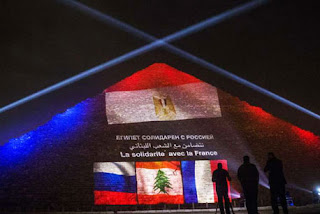
 Egypt’s Pyramids Light Up With Flags of France, Lebanon and Russia
The appalling attacks on Paris and Beirut just a few days ago have spawned a lot of comment over the internet, some of it constructive, a lot less so.

Personally I  am struck by the essential similarity between a massacre delivered on the ground and one delivered from the sky.

Maybe a fundamental question raised by such events is the old one about what such actions tell us about God, and about mankind.

It's a fundamental starting point to Christianity that people were created in God's image but that this image has become distorted and spoiled. In other words people are a strange mixture of good and evil, right and wrong, light and darkness.

So the basic question in Christianity is not why God allows things like these brutal massacres to happen, but what is he doing about them?

One answer lies in the bravery and selflessness shown by many in response to the horror around them - I am sure that in both Paris and Beirut there were far more people of courage and compassion than there were killers with their hatred and destruction.

But underlying that is a long term transformation of humanity: a preparation for a final cleansing which will bring healing and new life to a struggling world. The key enabling moment in that transformation was the death and resurrection of Jesus.

But that was nearly two thousand years ago! I trust that there is good reason for the long wait for Jesus' return and the transformation of heaven, earth and humanity that he will bring. Nevertheless, with the prophets of old, at times like this I have to ask:
"How long, O Lord?" 

PS: Clicking on the above image - a pyramid in Giza lit up with the flags of Russia, Lebanon and France - takes you to an extremely depressing list of terrorist attacks so far in 2015. One thing I do notice is that the vast majority are carried out by adherents of one particular extreme sect of Islam against members of more mainstream groupings within Islam - especially against Shia. Blaming Muslims in general for these attacks is about as accurate as blaming Christians for the actions of Westborough Baptist Church; although Wahhabist Salafists do get a lot more funding, thanks to Saudi oil money.