Friday, 11 December 2015

Autumn Moon Bands Day 2

Lyriel - Highlight of the festival
Back to Hamelin for the second day of the Autumn Moon music festival, not to mention the Mystic Halloween Market.

After getting up at 8am (groan!) for breakfast, we spent an enjoyable morning wandering around Hameln - a very pleasant little town, slightly touristy, the central area very close within the old town walls, with plenty of interesting things to see. Then, fortified by bread on a stick from the market, off to Sumpfblume  to start another day's music.


First up were Diabulus in Musica, a band who weren't in the original advertised lineup, I think, so we had no idea what they'd be like. As it turned out they were surprisingly good: a Spanish band playing orchestral-style FFM with a very pregnant-looking lead singer. Quite how she could sing like that with what must have been a pretty immobile diaphragm is a mystery. But they were an unexpected treat. The video clip above is very short and has poor sound, but it does nicely illustrate the singer's condition. Like many bands I enjoy, their sound includes light and dark, heavy and soft. If you click on the band name above and scroll to the bottom of the page there are some videos which give a better idea of their music.

After them we stayed in the Sumpfblume for Ravenscry, another FFM band from the Mediterranean, this time from Italy. They'd seemed quite reasonable on the preview video, but live they were painful. Bass and twin guitars all turned up to 11 on both fuzz and volume. No colour, no inventiveness and no sign of originality in the first two songs, so we left them to it.

Across to the Rattenfängerhalle for some supposed cyberpunk-rock, with Dope Stars Inc. Actually fairly generic punk-pop, even emo-pop: heavy on eyeliner and hype, light on originality. Okay, but not exciting.

Staying put, we had a change in style with Clan of Xymox, a kind of gothic OMD: 80's synth-rock, or maybe pomp-rock, brought slightly more up-to-date. Not really my thing but actually done quite well, I thought. In fact, they reminded me that I quite liked OMD back in the day.


I'm starting to get very tired at this point, so it was handly that the next band we wanted to see, Mythemia, were back in the Schiff, where I hoped to get a bit of a sit-down. No chance! Storytelling folk in a mix of German and English, based around myths and legends (hence the name, I guess), so lively and well-played there was no way I could stay sat down at the back. Brilliant, a real treat! If you get a chance to see them yourself, then do.

We had thought about about heading back to the Rattenfängerhalle next to see Leaves Eyes, the one band at the festival that we had seen before: Scandinavian symphonic FFM, with a new album out which had been receiving good reviews. But I was just totally shot, and going nowhere.


So we stayed on the boat and watched Laura Carbone instead; I'm really pleased we did, although I ended up back on my feet again. She's a female indie-rock singer, reminiscent to me of Sheryl Crow in her vocal style. But what really got me going was the band she had with her. They were just fantastic: the drummer and guitarist would start off doing drummy and guitary things but then just veer off in all sorts of strange directions and somehow the bass player would keep the whole thing together in a cohesive and exciting whole. Just wonderful: live music at its best!

Time for a sit-down and a bite to eat before I simply fell over where I stood.

Then to the Rattenfängerhalle for a band I'd been looking forward to: Beyond the Black. In the videos I had previewed they played quality melodic FFM, with hints of folkiness: very enjoyable. In the flesh they were a disappointment. Not too bad but a long way short of what I'd hoped for. Apart from the singer the band just seemed to lack musicality. Nearly all the time they had all the instruments playing basic rhythm and no-one  doing anything vaguely interesting with it. The vocalist was undoubtedly good, and when she played piano she made it interesting, but I don't know what happened to the rest of the band. A bad day at the office, perhaps.

Then off to Sumpfblume for Schwarzer Engel. Male-fronted operatic metal, okay in the preview video, if a little generic. Live they were more sledgehammer metal than operatic, but within that context surprisingly decent. Worth seeing, but not worth going out of one's way for, really.

By now it's close to midnight and I'm getting worried about whether Lyriel will be worth all the effort. After all we'd never seen them in the flesh, and Beyond the Black had just illustrated that bands don't always live up to their recorded promise when they're live. It would have been a long way to travel to see a disappointing band.


I needn't have worried. Half-eleven and the band come onstage, dressed in strange white masks - I've no idea why - and burst into Skin & Bones, the title track from their new album. Straight in with energy and presence, it was great! We were right at the front and their sound was beautifully balanced - cello, violin, guitar, bass, drums and, of course, voices, all coming through with clarity and vigour - and they played with great style and energy.

Lyriel are another band who vary their music, quieter songs amongst the metal, melodies weaving around the rhythms, folk and rock together. But live I really noticed the contrast between the sheer joy of the music and the often sad and heartfelt lyrics.

One advantage of a band with a violinist is that they can lead a dance around the venue - not quite a pied piper, more a dancing fiddler, but great fun nonetheless.

All in all, Lyriel were an absolutely wonderful climax to a brilliant festival, and an amazing way to celebrate our thirtieth wedding anniversary.

Saturday, 28 November 2015

Autumn Moon Bands Day 1

Four weeks ago BlackLin and I went to Hamelin in Germany (of Pied Piper fame) to a music festival there: Autumn Moon, which was sharing a site with the Mystic Halloween Market - of which more anon ... if I ever get to part three of this series of posts.

There was one band we really wanted to see, Lyriel, who only seemed to play in Germany, so if we were to see them we would have to travel. As Autumn Moon was the half term weekend shortly after our thirtieth wedding anniversary, we decided to treat ourselves.

Our lack of German language skills was a bit of a challenge, especially as Hameln is quite a small town so there was limited English spoken, but we managed.

The festival ran on three main sites: the Rattenfängerhalle - Ratcatcher Hall - was the main stage, then there was a smaller stage at the Sumpfblume - Swamp flowers - and a tiny stage on a ship - large barge really. The Mystic Halloween Market also had its own open air stage where some of the bands also played.

At 3pm on Friday things kicked off at the Rattenfängerhalle with Austrian band Serenity, a band who had previously supported Dio which seemed a good sign. They played melodic metal fronted by two vocalists - one male and one female - and were absolutely brilliant. Their music had colour, energy and interesting lyrics (in English). If the festival is using a band this good to open at 3 o'clock in the afternoon, what would the rest of it be like?

After buying a Serenity CD from their merch stall ,we wandered over to the Schiff for WaldKauz, a German folk band. The Autumn Moon website had provided links to YouTube previews of most of the bands, including Waldkauz. They looked okay on YouTube but not that exciting. Live they were far better, although folk in a foreign language has its limitations. Later they also played on the outdoor market stage, which actually suited them better, I thought, than the slightly cramped Schiff.

After that we had a choice: stay on the Schiff for Ye Banished Privateers, or pop across to Sumpfblume to see electro-pop-rock band Tüsn. We chose the latter. Tüsn were basically okay but incredibly pretentious. Fortunately we knew Ye Banished Privateers would be on later in the Rattenfängerhalle.

A bite to eat then back to the boat for Tibetrea: pagan folk with medieval instruments and female harmonies. Actually much better live than their YouTube videos had suggested. Good fun but not as exciting as some of the other folk bands we saw.

Then across to the Rattenfängerhalle for Megahertz: rock with a very deep male singer. Slightly weird but a bit too Alice Cooper for my taste.

I'm flagging by then, to say the least, but the boat had seats, if you didn't mind being a bit far back from the action. So back to the Schiff again for Dunkelschön's take on folk rock. As the name implies they mixed dark and light, with some lovely melodic songs interspersed with some much heavier and rockier tracks. Enjoyable.

Back again to the Rattenfängerhalle for Omnia: more pagan folk, this time from Bohemia. Interestingly their style of folk is quite eclectic and there was a good reggae beat going on at times. Enjoyable but, in spite of some interesting touches, in the end they became a bit repetitive.

We stayed put for the Friday night headline act: Deine Lakaien. Male voice over keyboards mostly; the YouTube video had sounded good but live I found them dull. That said, the hall was packed with people who were having a great time, so it has to be a matter of taste.

We popped over instead to the Sumpfblume to listen to Euzen who gave, I felt, the worst performance we saw that day. They play a kind of female-fronted indie pop. They had sound issues at the beginning; but even after they resolved these initial difficulties their sound remained unbalanced, too loud and frankly rather grim.

The Sumpfblume complex includes a cafeteria so we retreated there for a mysterious snack which turned out to be a kind of extra-thick pancake. Good sustenance for midnight after a couple of disappointing bands.

After Deine Lakaien finished Ye Banished Privateers set up in the middle of the audience area to play some really enjoyable pirate rock. I quite fancied seeing Trollfest, whose video shows them as basically playing bonkers rock/metal (click on the link above to see what I mean), but by then it was half-one in the morning and we were shattered, so we decided to quit while we were on a high from the Privateers.

So, day 1. Ten bands: six decent to good, two that we didn't enjoy, and two really excellent, in very different ways. Not bad for day one of a festival where we didn't know any of the bands before we booked. Oh, and some really interesting and very tasty food along the way.

Sunday, 22 November 2015

Darkness and Light in Paris and Beirut

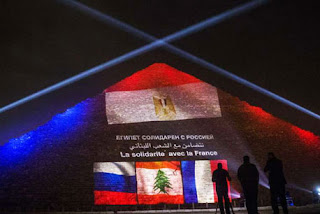
 Egypt’s Pyramids Light Up With Flags of France, Lebanon and Russia
The appalling attacks on Paris and Beirut just a few days ago have spawned a lot of comment over the internet, some of it constructive, a lot less so.

Personally I  am struck by the essential similarity between a massacre delivered on the ground and one delivered from the sky.

Maybe a fundamental question raised by such events is the old one about what such actions tell us about God, and about mankind.

It's a fundamental starting point to Christianity that people were created in God's image but that this image has become distorted and spoiled. In other words people are a strange mixture of good and evil, right and wrong, light and darkness.

So the basic question in Christianity is not why God allows things like these brutal massacres to happen, but what is he doing about them?

One answer lies in the bravery and selflessness shown by many in response to the horror around them - I am sure that in both Paris and Beirut there were far more people of courage and compassion than there were killers with their hatred and destruction.

But underlying that is a long term transformation of humanity: a preparation for a final cleansing which will bring healing and new life to a struggling world. The key enabling moment in that transformation was the death and resurrection of Jesus.

But that was nearly two thousand years ago! I trust that there is good reason for the long wait for Jesus' return and the transformation of heaven, earth and humanity that he will bring. Nevertheless, with the prophets of old, at times like this I have to ask:
"How long, O Lord?" 

PS: Clicking on the above image - a pyramid in Giza lit up with the flags of Russia, Lebanon and France - takes you to an extremely depressing list of terrorist attacks so far in 2015. One thing I do notice is that the vast majority are carried out by adherents of one particular extreme sect of Islam against members of more mainstream groupings within Islam - especially against Shia. Blaming Muslims in general for these attacks is about as accurate as blaming Christians for the actions of Westborough Baptist Church; although Wahhabist Salafists do get a lot more funding, thanks to Saudi oil money.

Wednesday, 4 November 2015

TED Talks & Preacher Training


I wonder if Bible Colleges and other theological training centres use TED talks as part of their training in preaching?

A talk with a serious message given by one person with minimal staging and taking less than 20 minutes - for churchgoers among you, does that sound familiar? If I add that the vast majority of TED talks closely engage both the immediate audience and, in many cases, millions of people worldwide then maybe the familiarity decreases.

I've been known to say that the traditional lecture-style sermon is way out-of-date and an appalling way of attempting to engage with modern people in the modern world. There is an elderly and declining population of churchgoers who often like them like that, of course, but I have long argued that a new approach is needed.

In many ways I still believe that: sitting passively consuming the words of a supposed expert is a lousy way to learn. Yet the global success of TED talks does suggest that there is life in the format yet, so I think it's worth looking at some of the typical characteristics of a TED talk.

Pretty much all TED talks are given by people with genuine and obvious enthusiasm and expertise who are speaking about something which they believe matters.

The vast majority have a speaker who moves around the stage, rather than being trapped behind a lectern.

Many TED talks involve some sort of projection/PowerPoint accompaniment, used as a visual backup and complement to the talk itself; whilst the talk remains the main focus.

Many of the talks involve humour - but rarely in the form of isolated jokes, more as ways of making or supporting a particular point.

Some of the talks involve some degree of interaction with the audience, but this is nearly always limited. People want to listen to the speaker and there is a tight timescale.

So I would say it is time for preachers to rethink their methods, congregations to rethink what they ask of their preachers, and occasional visitors to church to give more feedback on how they experience the preaching in that church.

If a preacher doesn't have expertise and enthusiasm then why on earth are they there? If the preacher doesn't make the effort to engage with the congregation through movement, interaction, relevant visuals and/or humour then why should they expect the congregation to engage with them? And if a preacher isn't talking about something which has meaning and importance to listeners and to their neighbours then why is s/he wasting everyone's time?

What do you think?

Tuesday, 27 October 2015

Sinners

Jesus famously said that he came to call sinners, not the righteous, but who did he mean by that?

To 20th-Century churchgoers the answer would have been obvious: sinners are the bad and the wicked, especially those whose wrong-doing has something to do with sex or the ten commandments. To early 21st-Century non-churchgoers sin is more of a marketing term, implying luxury and indulgence, with a hint of defiance against overweening authority.

In Biblical times the meaning was quite different. In contrast to the righteous, the δικαίους, who followed the rules and fitted into the framework of their society, sinners, the ἁμαρτωλούς, were those who had missed the mark, not kept to their society's rules. In the case of the Jews this was all about the covenant on Mount Sinai, and being God's people.

The book of Exodus tells of that covenant: God told the Israelites that if they followed his commands he would be their God and they would be his people. It was a contract, with definite terms and conditions.

A large part of the rest of the Old Testament tells of how the Israelites failed, again and again, to keep their side of the bargain. Eventually God withdrew his protection and the nation of Israel was driven out by the Assyrians; later Judea was taken into exile by the Babylonians. The Jews (aka Judeans) eventually returned to their lands, the inhabitants of the northern kingdom, Israel, never really did (there is some confusion about the status of the Samaritans, who claimed to be descendants of these Israelites although the Jews denied this).

Although the Jews (many of them) returned to their lands, they never really had control over them: Persians, Greeks and then Romans claimed authority instead. So, we can tell from documents from Jesus' time and earlier found over the past few decades, they decided that the exile was, in a sense, still ongoing. That God and his chosen king would eventually come and truly establish God's Kingdom of justice and freedom and peace ... at least for the Jews.

Part of this development was the idea that it wasn't enough to be a Jew to be one of God's people - you had to be a righteous Jew: one who truly follows all the conditions of that Sinai covenant. If you kept all the rules of the Law you were included in that promised Kingdom; if you missed the mark, failed to keep the terms of the contract, then you were a sinner, outside the Kingdom.

Of course, those of us who are Gentiles, non-Jews, are automatically outside the Kingdom, automatically sinners.

The trouble was that the religious authorities, who determined how those terms and conditions should be applied, interpreted them on their own terms. So, oddly enough, those who behaved religiously would be declared righteous, those who had to get on with normal life would find themselves being declared sinners, missing the mark and falling outside the covenant.

For example, their interpretation of the food laws effectively meant that Jews were not allowed to eat at the homes of Gentiles. At a time when Gentiles are in charge, that means that anyone working with the Romans or Greeks would soon be either out of a job - as eating together was an important part of the way that these relationships worked - or would be declared a sinner.

Similarly, anyone caring for the sick on a regular basis would soon find themselves doing or touching something they shouldn't, just as part of living. And anyone who actually was chronically sick - for instance the woman in the story who suffered from a long term haemorrhage - was excluded almost by definition.

People were excluded from God's Kingdom effectively because they were not rich and privileged enough to follow the lifestyle set as the target by the privileged religious leaders.

You begin to see why Jesus got so angry, perhaps?

There is an enormous amount of good in the Old Testament, including much that was amazingly progressive for its day. But the people in leadership, the ones who were supposed to make it work, instead abused and exploited their people in the name of God and of His covenant. A new approach was needed.

Jesus died on a cross, and rose again, in order that all those who could not qualify for membership of God's Kingdom under the old contract could take out a new one instead. A new contract which doesn't depend on following rules, but on following Jesus, and which focuses on including all who are willing to turn to God in order to be made new, and on welcoming the previously excluded into the family of God's people.

I just wish that today's religious leaders would properly come to terms with this.