Tuesday, 27 March 2012

Why I Think Rowan Williams Is A Good Guy

(Part of the reason anyway).

Lulu, the six-year-old daughter of journalist Alex Renton (who doesn't believe in God), wrote God a letter:
To God how did you get invented? From Lulu xo
After some thought (you can read the full story here), he sent a copy of the letter to a number of people, including the head of theology of the Anglican Communion, based at Lambeth Palace. After a while a reply came from Rowan Williams himself:
Dear Lulu,
Your dad has sent on your letter and asked if I have any answers. It's a difficult one! But I think God might reply a bit like this –
'Dear Lulu – Nobody invented me – but lots of people discovered me and were quite surprised. They discovered me when they looked round at the world and thought it was really beautiful or really mysterious and wondered where it came from. They discovered me when they were very very quiet on their own and felt a sort of peace and love they hadn't expected.
Then they invented ideas about me – some of them sensible and some of them not very sensible. From time to time I sent them some hints – specially in the life of Jesus – to help them get closer to what I'm really like.
But there was nothing and nobody around before me to invent me. Rather like somebody who writes a story in a book, I started making up the story of the world and eventually invented human beings like you who could ask me awkward questions!'
And then he'd send you lots of love and sign off.
I know he doesn't usually write letters, so I have to do the best I can on his behalf.
Lots of love from me too.
+Archbishop Rowan
The letter went down well with Lulu, we are told, especially the idea of "God's story". But best of all is Lulu's response when her dad asked her what she thought:
Well, I have very different ideas. But he has a good one.
 I'm sure the archbishop would approve.

Monday, 19 March 2012

Who We Really Are Ramble

Grandma?
I've never seen someone I love suffer from severe dementia, thankfully, but I'm told it is like seeing the person you know slowly disappear. I have seen someone I liked and respected fall prey to alcoholism - there is a sense in which it must be similar, as the person I know gradually disappears to be replaced by some strange, worn, ugly doppelgänger. It is a horrible and frightening experience, and one wonders what, if anything, can be done to bring that person back.

I believe in a core identity or spirit which is distinct from the personality (pneuma rather than psyche to be technical). I believe that this remains and therefore people should be treated with as much respect and dignity as possible, including addicts and victims of dementia. But relationships are primarily with the person, and that gets hard.

I heard a preacher recently talking about heaven "up there" ... saying nothing very meaningful to me. I believe in a resurrection "down here", when Jesus returns and heaven comes down to earth. When this earth is renewed, when injustice and hatred are replaced by love and justice, then we too will be raised and renewed - to be the people we really are, deep, deep down inside.

Part of who we really are lies in our deepest and truest relationships, so I expect to see those restored too. Although not necessarily as we expect: imagine someone we have only known as a quiet old grandma resurrected as a lively young flapper!

Now imagine someone you know who is self-obsessed and treats others appallingly. Maybe s/he has always been like this, or maybe they have become so because of things that have happened to them, or through bad choices they have made. Unless and until we meet them post-resurrection we have no way of knowing who they really are; although God does.

This post is turning shapeless, but I think there is something in here that I do want to say. Anyway it's a while since I did a 'ramble' post, so I'll adjust the title a little ;-)

Friday, 9 March 2012

Prayer & Change

I reckon you could call prayer without action 'empty religion', action without prayer 'irreligion', and preparation, prayer and action working together 'changing the world'.

I see all three in churches, but recently there seems to be a lot of emphasis on the first 'empty religion' approach. Which is a pity, because the world is a long way from how it should be.

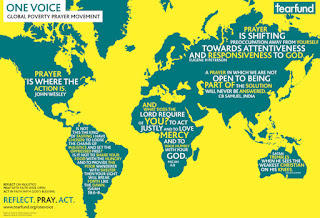
I've recently heard three rather different examples: a super talk by a young woman from TearFund (which is where the picture came from, click on it to see a larger, clearer version); a less super claim at a religious concert that 'my God is wealthy enough to deal with all your debts' (in a slightly grating Belfast accent); and the, at best ambivalent, suggestion shortly after Christmas that if your credit card is maxed out then 'take it to the Lord in prayer and stop worrying' (that one in a Yorkshire accent, as it happens).

In a previous recession I myself had a fairly serious credit card problem - the 'take money out of one card to make the minimum payment on the other' game. Burying one's head in the sand is a classic response to debt, so the suggestion that one can simply tell God about it then carry on ignoring the debt is really not a helpful one. On the other hand, talking to God about the problem and your worries then listening to what God says and acting on it - probably to DO something about the debt - and trusting Him enough to stop worrying whilst you act ... that's a different matter. So I call the suggestion 'ambivalent' because whilst the preacher may have meant the active latter, I strongly suspect many of his listeners heard the passive former.

It's not just 'doing' though: typically real, two-way, prayer results in change - change in attitude and change in approach. To forgive someone when they have really harmed us is incredibly difficult, and often takes a long time. But not forgiving continues to cause further harm. Prayer and change of heart go together: the journey may be long and hard but, in prayer, God is with you all the way.

Of the various quotes featured on TearFund's 'Reflect, Pray, Act' poster, my favourite is from CB Samuel: "A prayer in which we are not open to being part of the solution will never be answered". God is not our gofer  - He helps us, encourages us, supports us, wants us to grow and wants us to take responsibility for our actions. The Church is meant to be Jesus' hands and feet, heart and mouth.

The expectation in any prayer should be that God will respond and that we will be asked to take part: sometimes by waiting trustfully, sometimes by resting in the assurance of His love, sometimes by changing our attitudes, sometimes by saying something that needs to be said, often by changing our behaviour, often by getting our hands dirty. God will be with us throughout, and together we really can change the world for the better. "Your Kingdom come" and all that.

Thursday, 16 February 2012

True Religion

Religion that God our Father accepts as pure and faultless is this: to look after orphans and widows in their distress and to keep oneself from being polluted by the world.
James 1:27
Continuing from my last post, about Jefferson (aka Jeffrey) Bethke's Why I Hate Religion But Love Jesus poem/video: the above Bible verse makes it clear that God, and by implication Jesus, is not against all religious behaviour. This is no criticism of Bethke - his is a poem not a carefully balanced argument - but it should be a starting point in considering how to respond to that poem.

The other useful reference point would be clarity about what we mean by 'religion' anyway - something which all the responses I have seen manage to forget.

A key point to consider is why that poem resonates so widely. Those who have publicly responded to Bethke seem to miss this reality: 'religion' has become a very dirty word, not just among young churchgoers, but within much of non-churchgoing society. I see it in New Scientist, a scientific magazine (really!) which has become outspokenly anti-religion over the past decade or so, and I see it as a general trend within the liberal end of the media, in letters pages, and in comments across the internet.

In many ways I can see their point:-
  • The US religious right has spent the past twenty years becoming increasingly vocal and influential with their rhetoric: anti-education, anti-science, anti-healthcare, anti-environment, anti-gay and now anti-women.
  • The attack on the Twin Towers by religious/nationalistic extremists, followed by other atrocities around the world.
  • The Middle East: the wars in Iraq - presented as religious 'crusades' - and Israel's unopposed flouting of international laws and standards.
  • Roman Catholic child abuse scandals. Some blame religion for the child abuse (unfairly: child abuse happens at least as frequently in a non-religious context); others for the cover-ups and for allowing abusers to re-offend elsewhere.
  • The Anglican/Episcopalian church tearing itself apart over equality of treatment for women and homosexuals.
  • Intercommunal violence between groups with different religious affiliations: Northern Ireland, Bosnia, Nigeria, and so on.
  • General partisan bickering within 'Christianity': protestant against catholic, evangelical against liberal, Calvinist against Arminian, little-enders against big-enders, whatever.
Responses along the lines of 'our religion isn't like that' honestly don't help.

"What if I told you, Jesus came to abolish religion?" -  I'd reply that there is no evidence to support that in the Bible. Equally, there is no evidence that Jesus came to start yet another religion: the Bible tells us he came to save the world, surely much more important.

It's not really that "Jesus and religion are on opposite spectrums"; comparing Jesus and religion is like comparing apples and aadvarks: what Jesus did and what religion does are qualitatively different.

"One is the work of God one is a man made invention ... because religion says do, Jesus says done." These two phrases make an important point ... one which can as easily be positive as negative.

The Bible tells us that Jesus came to save the world, to rescue humanity, to bring an end to sin (injustice, abuse, intolerance, hatred, that sort of thing). We are given the opportunity to accept what Jesus has done and to become a part of God's Kingdom, citizens in the new world that God is preparing. We can become Jesus' followers, disciples, children of God, however you like to put it. But that is a beginning not an ending.

Accepting what Jesus has done for us through his death and resurrection is the beginning of a journey, not the end. If we have become followers of Jesus then we need to live as such. Jesus has saved us, now we need to live in that salvation. God has done, so we must do. As the apostle Paul wrote to the church at Ephesus:
For it is by grace you have been saved, through faith ... created in Christ Jesus to do good works, which God prepared in advance for us to do.
If religion is the doing, then religion is intended to be the way that Jesus' followers respond to God's grace. Religion is humanity's answer to God's mercy.

But humanity is fallen, we may be saved but we remain part of a world that has gone horribly astray. Some followers of Jesus take their eyes off him and miss the point; many others want to follow God but have never met him. We try to live out God's love together and it often goes wrong.

Religion is not binary true/false, bad/good. Religion is a spectrum, from more true to God's way to less true. It covers those who don't know Him and are trying to do their best in their own strength, through those who are desperate to be Jesus' disciples but don't really know how, and those who just want an excuse, a fig-leaf for their own hatreds and intolerance.

Religions support the poor and they encourage repression of the poor; religions promote love and they preach hatred; religions stand up for education for all, and they oppose teaching of truth. Religions can be a blessing or they can be a curse ... just like any other human activity.

Religion is not the real problem, fallen humanity is the problem. And for that Jesus is the solution.

Friday, 10 February 2012

Love Jesus, Hate Religion, Tickled By People

There's a poem by Jefferson Bethke, Why I Hate Religion But Love Jesus, gone viral on the internet in the past month. Especially amongst church teenage groups. Most of whom were brought up in church. What I would call 'religious kids'. You have to smile.


Also fun are some of the responses to the video. Religious people giving religious responses which mostly show that they just don't get it. You can see a good selection in a post on the Sojourners' God's Politics blog, Follow The Meme: lots of sincere people making lots of good points in defense of their religions.

I think one job of a poet is to make people think: Bethke has clearly succeeded in that. Another job is to move readers into seeing a different perspective, a bigger picture. The responses linked to above don't really seem to do that: they just stay defensively hunkered down in their old perspective. That's a shame. It's not Bethke's fault, it's just how these responders choose to react.

What Bethke's poem fails to do, in my view, is to help the opposite pole see a bigger picture. It challenges those inside the religious establishment to look beyond their walls, but I see no challenge to those outside the church to look inside: to see past the stereotypes, the media headlines, the loudmouth spokespeople, and to see the mostly-ordinary men and women trying to live out their faith together in the day-to-day realities of life.

Nick Mason, on his blog New Ways Forward, recently wrote an article about the need for us to define ourselves more by what we affirm and less by what we oppose:
Eventually we must break away from the pull of finding our identity in conflict and opposition, and be for something.

There will be things that need to be spoken out against from time to time, but perhaps it is more important, and more effective, if we spend our energy creating something beautiful, powerful, and transformative.
Eric Metaxas, at last week's US National Prayer Breakfast, gave a long (although entertaining) illustration of the positive side of the difference between religiosity and active faith that comes from the heart, using the examples of Wilberforce and Bonhoeffer.

There are around about a dozen churches here in Caversham, filled every Sunday with lovely people singing and praying to God. Meanwhile there are around about another thirty thousand people who are not doing this, and who don't see any meaning or relevance for such activities in their lives. The church-goers are focussed on their church, as an organisation, as a building, as a set of practices and behaviours which they find helpful, even life-giving; the church-abstainers wonder what they are on about.

What would Church look like if it was for the thirty thousand? How could Jesus be embodied in the lives and fellowship of those who need something more, or at least something different?