Showing posts with label God. Show all posts

Saturday, 4 November 2017

The Last Word?

I once knew a middle-aged lady whose marriage fell apart after the kids left home. A while after her husband moved in with someone else she found a lump on her breast ... which she carefully ignored ... and ignored ... until at last she could ignore it no longer.

She underwent treatment for the breast cancer and came through. During her phased return to work they found a secondary in her brain, which killed her. At her funeral a neighbour said:
"It's hard to believe in God when something like this happens."
I knew another middle-aged lady who had a very difficult childhood. In her twenties and early thirties she fought back and thrived, making something special of her life. Then the demons caught up with her, gradually tearing much of what she had achieved apart and eventually killing her:
It's hard to believe in God when the demons win.
I can see the point, but for me it is far harder to not believe in God when such things happen. To not believe in God is to say that disease and demons have the last word.  To me, God is about meaning and purpose even in the midst of destruction and despair, about Resurrection when evil seems to have won.

For those of us who do make it through middle-age there is another 'd' waiting - decay. The longer we live the more we fall apart. In God I can even see meaning in that; but without God there is little to learn, or at least not much future in learning it.

I believe God has the last word: after disease and demons and decay and despair have done their worst, God still has something to say. And God's final word is about hope and love and life and purpose and a new future in a world of justice and peace and meaning.

But sometimes I do feel very, very tired.


Saturday, 7 May 2016

The Story Of Jesus' Body

 Church as people
When they had come together, the disciples asked Jesus, ‘Lord, is this the time when you will restore the kingdom to Israel?’ He replied, ‘It is not for you to know the times or periods that the Father has set by his own authority.  But you will receive power when the Holy Spirit has come upon you; and you will be my witnesses in Jerusalem, in all Judea and Samaria, and to the ends of the earth.’  When he had said this, as they were watching, he was lifted up, and a cloud took him out of their sight. (Acts 1:6-9)

I have a fairly visual imagination and I have to say that I find that final image in the Ascension story really unhelpful. It brings to my mind Flash Gordon, or maybe James Bond in Thunderball with his jetpack: Whooooosh!

That's not an picture I find helpful or relevant to what is going on at Jesus' ascension. So maybe another way to look at it is to tell the story - briefly - of Jesus' body from beginning to end.

“In the beginning was the Word,” we are told, “and the Word was with God and the Word was God … all things were made through him.” We start the story with Jesus not having a body at all – indeed with there not even being a universe to put a body in! God made everything with Jesus, including space and time. Where was God when he did this, if there was no space? When did he do it, if time didn't yet exist? Welcome to the head-exploding world of General Relativity – invented by God, described by Albert Einstein!

If that’s not head exploding enough, how about that Word – the one who helped create the whole space-time universe – suddenly appearing inside that universe, localised to a tiny helpless baby! Jesus now had a body, albeit one that was small and terribly fragile in the grand scheme of things. Somehow this whole impossible mystery gets glossed over every Christmas, but it's a reminder that we really shouldn't expect to be able to get our heads around everything God does -he's just too big and too wonder-full.

The baby Jesus grows up, teaches, makes friends, gets to know people, then he’s killed, on a cross. So, how can you kill God? How come the universe kept going that weekend when Jesus wasn't around? And so on; I hope you're getting the idea that if it doesn't make your brain hurt you're not really understanding the story.

Jesus’ dead body is laid in a tomb, and a rock rolled across the front. But that first Easter Sunday Jesus’ friends came to his tomb and found the rock rolled away and the tomb empty. Later they met him, on a number of different occasions, in various different places. Jesus was alive; he had risen! His body is transformed but living; death is overcome, wrongdoing forgiven, the way to life is open to all.

The risen Jesus spent some time with his friends, but then he had to go away, to be lifted up and to disappear from sight in a cloud. Where did his body go? Presumably back to where he started – somewhere outside space and time … my head’s starting to hurt again.

Maybe a better question is why did Jesus have to go? Actually, Jesus had already told his friends this before he died (John 16:7) – he told them that he had to go so that the Holy Spirit could come. And we are told later in the Bible that the Holy Spirit is what unites Jesus’ followers into Jesus’ new body – one body: Jesus’ hands and heart, feet and voice.

We're having a baptism at St John's tomorrow, and when we baptise the child we will welcome her into the body of Christ, which is the church. Sometimes people say that the church is people, not a building; strictly speaking I think it is more accurate to describe the church as a building made up of people.

Finally, the story of Jesus’ body ends – or maybe comes to a new beginning – when Jesus returns, when we are all raised to a renewed world of justice and peace, and when there will be, we are told, the most amazing party, at the Wedding of the Lamb!

That's a brief whistlestop tour of the story of Jesus' body. I've thrown in various brain-bending questions as I go - if you are of a scientific bent I hope you found them entertaining. However there are a couple of more important questions which I believe arise from that story:-

Firstly, where do we fit into this story of Jesus body? Obviously if we're there at all (and I suspect we all are, somewhere) then we’re something to do with the part of the story where his body is his church, but where are we within that? Some of us are regular churchgoers – what is our place in Jesus’ body, what does it mean in our lives, day to day? But the same question is for those who do not go to church regularly, or even at all, where do you fit into Jesus’ body, and what does it mean in your life?

Tomorrow this will have special relevance in the context of the baptism of a child at St John's – everyone will be making various promises about the child and her place in that body: churchpeople, family, friends and wellwishers, parents and godparents. What is and will be the child's place within Jesus’ body, today, throughout her childhood, and beyond? And how can those present play their part in that? It’s something to ponder.

My second question is about what sort of God this is? What sort of God loves us all so much that he’ll do anything for us, even going through all this faffing about? The Word through whom the universe was made suddenly shrinking down to become a baby within that universe. The man walking the roads of Galilee and Judea, who dies on a cross for us, and is raised. But most of all perhaps, what sort of God would let the likes of us be His body? Flawed, messed up, dreadfully human people like you and me being Jesus’ body in the world? What sort of people would you trust to look after your body (Red Dwarf example springs to mind - bonus geek points if you give the episode in the comments below)? Who is this God and why does he care so much for us?

Not questions with simple answers, perhaps, and my answers are unlikely to be the same as yours. But I do hope that you find them questions worth pondering.

I also pray that everyone attending tomorrow's baptism, on this First Sunday After Ascension, may come to know deeply the love of God who will do anything for them (and you), and that through that love they (and you) will find their/your place in Jesus’ body, here in Caversham. there in your home town, and beyond.

Finally, a cake version of the picture at the beginning, what better way to finish could there be?

The Reason for Jesus' Ascension

Sunday, 22 November 2015

Darkness and Light in Paris and Beirut

 Egypt’s Pyramids Light Up With Flags of France, Lebanon and Russia
The appalling attacks on Paris and Beirut just a few days ago have spawned a lot of comment over the internet, some of it constructive, a lot less so.

Personally I  am struck by the essential similarity between a massacre delivered on the ground and one delivered from the sky.

Maybe a fundamental question raised by such events is the old one about what such actions tell us about God, and about mankind.

It's a fundamental starting point to Christianity that people were created in God's image but that this image has become distorted and spoiled. In other words people are a strange mixture of good and evil, right and wrong, light and darkness.

So the basic question in Christianity is not why God allows things like these brutal massacres to happen, but what is he doing about them?

One answer lies in the bravery and selflessness shown by many in response to the horror around them - I am sure that in both Paris and Beirut there were far more people of courage and compassion than there were killers with their hatred and destruction.

But underlying that is a long term transformation of humanity: a preparation for a final cleansing which will bring healing and new life to a struggling world. The key enabling moment in that transformation was the death and resurrection of Jesus.

But that was nearly two thousand years ago! I trust that there is good reason for the long wait for Jesus' return and the transformation of heaven, earth and humanity that he will bring. Nevertheless, with the prophets of old, at times like this I have to ask:
"How long, O Lord?" 

PS: Clicking on the above image - a pyramid in Giza lit up with the flags of Russia, Lebanon and France - takes you to an extremely depressing list of terrorist attacks so far in 2015. One thing I do notice is that the vast majority are carried out by adherents of one particular extreme sect of Islam against members of more mainstream groupings within Islam - especially against Shia. Blaming Muslims in general for these attacks is about as accurate as blaming Christians for the actions of Westborough Baptist Church; although Wahhabist Salafists do get a lot more funding, thanks to Saudi oil money.

Wednesday, 5 August 2015

One God In Community

The Christian picture of a Trinitarian God does have some important consequences.

A key implication is that the Trinity in some way reflects an important property of God's nature: that he is in an essential way relational; that community is somehow central to the creator of the universe.

One has to be really careful here, of course, not to go confusing a Trinitarian picture of God with some kind of cosy human family gathering. God is much, much more than that; but it is likely that He is not less than that.

Notwithstanding the Western Church, over recent centuries, slowly but surely moving to a focus on individualism and on each individual's relationship with God, the pattern of the Bible is very different.

From Genesis, where it is not good for man to be alone, throughout the Old Testament, with its emphasis on God's dealings with His people, to the New Testament, where the story moves from Jesus with his disciples, to the Spirit working in and through the Church, Jesus' body, the Bible is about communities of people following (or not) God.

One way of presenting the 'big picture' of the Bible is about relationships: broken in the opening chapters and being restored by Jesus' sacrifice and the power of God's Spirit. Relationships between people and God, between people and other people, and between people and the natural world, God's creation. These are still issues in our world today - the Bible story doesn't end with the final page of Revelation, it carries on through the lives and work of Jesus' followers throughout history - until the day Jesus returns and makes all things new.

I would argue that this is how you can tell the true Church, Jesus' real followers: are they in the business of restoring relationships or of harming them? Not that even the best churches don't make mistakes and wander off the path, but one can still question both the overall pattern, and the quality of the hopes and dreams of the members: do they build up and welcome in, or do they knock down and exclude?

The Bible tells us that "God is love", and love is the essence of true relationship. If God is love then his followers must also be love, and must ensure that their understanding and practice of that love follows the radical patterns laid down by Jesus. Love isn't about gooey feelings and sex, but about genuine and practical care for someone else, backed with a willingness to sacrifice oneself to meet their deepest needs. To love is to to take up one's cross for the sake of another.

Love starts with loving God with all that we are, continues with loving our neighbour as our selves - even when that neighbour is strange, foreign, or in some other way 'alien' - and ends with God's people loving one another.

Remember that God's love for you is far greater than any human love.

God loves you, He died for you: he is on your side. God is not out to get you, He is out to save you. But He always gives you a choice: love respects freedom of choice. As a parent of young adults I suspect I have a very faint insight into how hard that must be ... even for God.

Saturday, 1 August 2015

One God Indivisible

As the early church became separated from its Jewish roots, it became more and more important to pin down just what the New Testament writers meant by some of the things they had written about Jesus.

Paul and John were both religious Jews, and therefore strongly monotheistic. So what did they mean by phrases like:
"For in him [the Son] all things were created ... he is the head of the body, the church ... the firstborn from the dead ... God was pleased to have all his fulness dwell in him," 
from Paul's letter to the Colossian church; and
"In the beginning was the Word, and the Word was with God, and the Word was God ... The Word became flesh and made his dwelling among us ... the one and only Son, who came from the Father," 
from the opening of John's Gospel?

It took several hundred years of argument, but in the end the church settled on the idea of a Trinitarian God - one God in three Persons - and that Jesus was both fully God and fully man, in one person.

Jews don't like this solution, Muslims don't like it either, and an assortment of Christian offshoots over the centuries have rejected it as well. So why is mainstream Christianity so attached to the idea of a Trinitarian God, what does it mean, and how is it monotheistic?

In my view, at the heart of the issue is the reality that God is essentially unknowable. How can anyone get their heads around a being who created the whole space-time universe out of nothing? If He created time, when did He do it; if He created space where was He when He did it? God is beyond space and time, but we have no way of understanding that. It's a reality which Kierkegaarde and Karl Barth described as infinite qualitative distinction (that Wikipedia reference isn't very good - if you know a better link please let me know).

So how can we talk about God as a person (or even as three persons)? How can a being beyond space and time relate to ordinary people in any meaningful sense, and how can we engage with, or even worship, such a being?

The answer has to be through God's self-revelation. We can't understand God (someone once said that anyone who claims to understand their God worships an idol). Nevertheless God can reveal himself to us - in a necessarily limited way - such that we can engage with that revelation. The Abrahamic religions understand that self-revelation to be through their scriptures and through creation, God's handiwork.

To Jews God reveals Himself through the Torah (and the Prophets), to Muslims through the Quran, and to Christians through the Bible. Scriptures are famously obscure and ambiguous in parts, so that revelation is modulated by the universe around us - God's creation - and by the way God has dealt over the centuries with His people.

Note, incidentally, the problems of language in describing God: God doesn't have gender, yet his self-revelation in the various scriptures is personal, so none of 'he', 'she' or 'it' really works well, but one must use something. So I'm using the traditional 'He', in spite of its limitations.

One self-revelation equates to one understanding of God which sits comfortably with monotheism. But what if God reveals himself in other, significantly different, ways?

What if God somehow revealed himself in a person? A person who in some mysterious way was both fully human and fully an expression of the one God? We can't begin to understand how that works of course, but then God is essentially not understandable - all we can do is appreciate his presentation(s) of Himself to us. A person is qualitatively different from a book; a human being localised in time and space has to be understood differently from the creator of that time and space. One God has revealed Himself in two fundamentally different ways.

Then there is the Christian experience of some sort of inner presence within them, which in some mysterious way unites them with other Christians, with Jesus, and with the otherwise unknowable God. A kind of Spirit which connects the human and the divine - inevitably almost indescribable and incomprehensible, but subjectively experienced as God revealing himself to us.

Three ways in which one God reveals himself to mankind - to you and I if we have eyes to see, ears to hear, heart and mind to experience. Creator and author, redeeming human being, and uniting restoring Spirit. One God revealing Himself through three 'persons' - self-expressions with whom limited humanity can relate.

A Trinitarian God who remains one God indivisible.

Wednesday, 15 July 2015

Mark: Triumph Over Death

The end is nigh! This is the final week of the CTM Parish's Mark sermon series, as we come to the end of Mark's Gospel. Of course, we all know how the story ends - it's pretty much summed up in the title above ... isn't it?

Except that Mark doesn't really tell it that way.

At the end of last week's instalment, the trap had closed - Jesus was on his own, betrayed, abandoned and captured. The religious authorities had taken him and planned to exact their revenge. The outlook was bleak.

They give Jesus a mockery of a trial, and are still having trouble making their case. So Jesus helps them out, agreeing that he is "the Messiah, the Son of the Blessed One." A reminder that Jesus is no helpless victim in this process; he has been prodding and poking and shaming the religious leaders to provoke a reaction from the beginning. He is not letting them off the hook now: they can choose to do evil or they can choose to do good, but they must choose.

Off to Pilate, the local leader of the occupying Roman power. He is playing his own games, but has no interest in blocking a determined drive by the native powers-that-be. Jesus is tortured, mocked and condemned to death.

Then they crucify Jesus.

There's more mockery, mostly along the lines of 'if Jesus is really who he says then he'll come down off the cross and avoid the suffering and death'. Maybe it's a cry of anyone faced with suffering: surely if God loves us then he would save us from this. Yet Jesus is telling us - as he has told us before - that in God's upside-down Kingdom life comes through death, and healing through wounds.

Mark's readers in Rome had been forced to endure terrible suffering and loss: they had made it through, but how to make sense of the cost? Mark, as ever, doesn't give a clear explanation, he just shows Jesus on a cross. Jesus quoting an ancient Hebrew song: a song which begins in lonely suffering - "My God, my God, why have you forsaken me?" - but ends in vindication and triumph, "All the ends of the earth shall remember and turn to the Lord; and all the families of the nations shall worship before him."

The sun goes dark, Jesus breathes his last, and the curtain in the Temple is torn in two. Just as the heavens had been torn apart at Jesus baptism, for God to affirm Jesus as his son, now the veil of the Temple - symbolically separating God from the people - is torn apart, and the foreign NCO in charge of the execution squad affirms Jesus as God's son.

It's strangers and religious leaders who have condemned Jesus, but it is also strangers and a religious leader who help him: Simon of Cyrene who carries his cross, the unnamed centurion who tells his identity, and now Joseph of Arimathea lays Jesus in his tomb. Women - two Marys - look on.

After the Sabbath is over the story takes a twist: the tomb is empty, Jesus is not there.

Our best estimate of the original ending is that the three women were told to tell the disciples that Jesus had been raised and is going ahead of them to Galilee, but they "said nothing to anyone, for they were afraid." That's it: the alternative endings given in most Bibles are believed to be later additions.

But how can the story be known, how can Jesus' resurrection be known, if the women kept silent? That's the point, of course. They were terribly afraid, they wanted to keep silent, but at some point they must have spoken out anyway. And so the Church began.

In late 60's Rome Christians were terribly afraid, they would have wanted to keep silent, but what would they actually do? Can the Church carry on? Mark's Gospel is open ended.

In early 21st-Century Britain many Christians seem ... unwilling to speak up; at least those who are not modern day Pharisees. Uncertainty about what it all means, doubt about the place of faith in a secular world, unwillingness to force one's beliefs onto another, many different reasons perhaps.

But if the end result is that those who faithfully and lovingly follow Jesus are not heard, if the message of God's Grace through Jesus is drowned out, how can the Church continue?

Now, as then, Mark's Gospel remains open-ended.

Sunday, 12 July 2015

Mark: Are Wives Like Cars?

Maybe you know what it's like: you get your first job, you can afford to buy your first car ... and it's wonderful! Beautiful, shiny, the feeling of freedom.

A few years later, the car's a bit less shiny, a bit tatty round the edges, perhaps, doesn't go quite as well as it once did; anyway, you've done quite well for yourself, you can afford better, something that shows off your success. So you trade in your old car and buy a nice shiny newer, better one.

Is that how it is with wives? Is it how it should be?

As a rule of thumb, if you think Jesus is setting down a command, a law, a line you mustn't cross - you probably haven't understood what he is talking about. That certainly applies to what he said about divorce (taking that passage from Mark slightly out of sequence). It begins with the Pharisees seeking to 'test' Jesus: "Is it lawful for a man to divorce his wife?"

We know, from other writings, that this was a live question at the time: not so much the question of lawfulness - that was just the opening gambit - but the question of what was sufficient reason for divorce. Can a man divorce his wife (it was always that way round, by the way) for any reason he fancies (like changing his car), or is it only for specific reasons, such as persistent infidelity or - 'obviously' - infertility.

The Law of Moses is, at first sight, clear: "Moses allowed a man to write a certificate of dismissal and to divorce her". Incidentally, the point of that 'certificate of dismissal', or Get, is that it states that the woman is free to remarry.

On the other hand, the Prophets seem divided: "For I hate divorce, says the Lord, the God of Israel," as Malachi puts it. But there are also prophets who talk about divorce as the appropriate response to extreme infidelity (generally as an analogy with Israel), for example in Jeremiah: "For all the adulteries of that faithless one, Israel, I had sent her away with a decree of divorce."

Jesus would have been expected to do the rabbinic thing of bouncing around these quotes (and others, especially Hosea), along with precedents and other rabbis' teachings, before coming up with a balanced judgement about when it was right for a man to divorce his wife, and when not.

Jesus doesn't play that game.

The underlying assumption of the question is that wives are possessions. Either possessions which can be freely traded, like cars, or functional items whose job is to provide (legitimate) children ... dynastic enablers, if you like. This assumption is (in)famously reflected in the tenth commandment, not to covet a neighbour's house, wife, slave, ox or donkey.

Jesus comes at the issue from a different angle - for Jesus the starting point is the beginning of the Bible, in Genesis 1, where God creates humanity in his own image, male and female together, to work in partnership looking after his world.

Women are not 'things' to be possessed but colleagues and companions to be joined with in true partnership. There are families to raise, together, communities to build, together, and a fallen world to heal, together. That's the way marriage was meant to work ... sometimes it does and sometimes it doesn't, but God's intent should be the starting point for discussion.

Divorce is allowed in the Old Testament for when this breaks down, for 'hardness of heart' as Jesus puts it. The commitment, 'contract' if you like, is for lifelong faithfulness to one another, and is before God, so don't treat it lightly.

But 'hardness of heart' is as real today as it was in Ancient Israel. Violence, abuse, abandonment, and extreme unfaithfulness can all destroy a marriage - the wrongdoing is not the certificate of divorce, but the (possibly many) factors which caused the breakdown.

Technically, the most faithful wife, once divorced and remarried, breaks her original commitment when she first sleeps with her new husband. Then the first contract is broken, annulled, and a new contract established, hopefully one which will last, bringing healing and purpose - the way God intended marriage to be.

I usually try not to criticise other church traditions on this blog, but to me the Roman Catholic church's take on divorce and remarriage - refusing communion to the new family - is simply heartless and evil. The new Pope has suggested he wants to change this, but to have treated people that way at all is simply wrong.

So if Jesus isn't giving a rule here, yet another burden, then what is he saying?

Firstly that marriage is a precious union of equals, a lifelong commitment before God. Do everything in your power to make that work for good.

But do also recognise that we live in a fallen world and relationships do go wrong. If so, the Bible gives us a way out. Divorce should never be taken as an easy option, but sometimes, because we all have hard hearts, breaking the old covenant and starting anew, before God, is the only way forward.

God loves you and is on your side, trust him with all that you are.


Friday, 3 April 2015

Life Matters

If a puppy was born with a badly deformed heart, so it was in pain and distress, if it needed a long series of major operations to have even a chance of growing up, most people would sadly take it to the vet to be painlessly put down, I suspect. It would be seen as a mercy.

I have known two babies born with badly deformed hearts. Both suffered pain and distress and went through a long series of major operations, without a great chance of success. So far, both have made it through: they are battlers. In their short lives they have known far more than their fair share of suffering, but they have also known much joy and love.

Should they have been put down at birth, or even before? I suspect most of us would strongly feel they should be given their chance at life, although some high-profile figures might disagree. Somehow life is important and its quality depends on more than just lack of pain and life's significance lies in more than just its length.

Good Friday is a day when Christians remember the suffering and death of Jesus, we believe for the sake of the world, so that all who put their trust in him may have fullness of life, forever.

I think this has relevance to the suffering that goes on in the world; although no way would I claim a complete answer to this venerable question (recently brought up by Stephen Fry and treated by the media as if it were a new thought).

Why do we live in a world where children are born with deformed hearts? I don't know, but I do believe that their lives matter, and that surrounding them with all the love we can matters, and that their parents are heroes who should be celebrated.

Why do we live in such a world? One answer is that God is either incompetent (or at least not omnipotent) or evil. This is slack logic: these may be two options, but they are not the only two. One other that strikes me is that any alternative may be worse.

Why did the parents of these babies allow them to go through such distress? Because they believed that their lives mattered, and they did whatever they could to allow their child every chance to experience life and love and joy. They could have wiped the slate clean and started again, but they chose not to. That individual baby mattered.

Our lives matter to God: that we find love and joy and meaning is, I believe, his priority. Rather than wiping the slate of the world clean, he gave his son to live with us and to die for us, so that we might have every chance to find that love, joy and fulfilment. Every loving parent knows that there is a price to be paid for their love; sometimes that price is hard to bear. God, through Jesus, paid the highest price, because he loves us and because our lives matter to him.

There may be all sorts of other reasons for the suffering in this world. I don't know, I am not God. But I do know that faith is about trust.

I trust that God is good and loving, and that life is in him. And life matters.

Saturday, 29 November 2014

Advent Hope

"£25m Pay Deal Criticised" - BG group, headquartered here in Reading, are hiring a new CEO, Helge Lund, who wants £25 million for his first year. He may or may not get all of it, but the reality remains that the rich are getting richer and the poor are getting poorer. The reason is simple: the rich have the power to decide where the money goes and so they take it; the poor don't have power so they struggle to feed their families. It seems to me that there should be a reckoning for this, an accounting, a judgement if you like.

"Kassig Had ‘Calling’ To Help Syrians" - Peter Kassig was kidnapped and killed by the IS/ISIS/ISIL and a video of his death posted. What western media rarely mentions is that around 14 Syrians were also murdered on the video, an omission that seems to me to play into the hands of the IS propagandists. Nevertheless, what we have in Syria and Western Iraq is a situation where men (mostly) of violence are slaughtering people of goodwill and good intent. Surely that demands a reckoning, an accounting, a judgement.

"Rotherham: Tip Of The Iceberg" - At least 1,400 vulnerable children abused by a paedophile ring. Why the 'tip of the iceberg'? One reason is that there are now investigations into other paedophile rings operating in other towns and cities across the UK. The other is that police chiefs are now saying what the NSPCC have been saying for years: that all of these paedophile rings are only the tip of the iceberg of child abuse in this country - the vast majority of abuse takes place in or around the home, carried out by family members or family friends.There has to be a reckoning, an accounting, a judgement, and it must come soon: every day more children and young people are suffering.

What is God doing about all this?

Which brings us to Advent. Advent is not just looking back to the first Christmas, celebrating Emmanuel, God with us, and wondering about all that God was doing. Advent is also about looking forward in hope. In the church calendar, last Sunday was the Feast of Christ the King; for the next few Sundays we look forward to the return of King Jesus to earth to reign in power over a new Kingdom of justice and peace. Sounds easy?

Back in the days of the Old Testament prophet Isaiah he wrote warnings about the consequences of the injustice, greed and violence racking his nation. Many of his passages have a thick dark thread of warning, interwoven with a fine gold thread about God intervening personally to sort things out. The warnings in due course came true, back in 587BC when the Babylonians destroyed Jerusalem and exiled many of its people. Injustice piled on injustice, with greed, violence, poisonous politics and exploitative religion, had built up a toxic brew which eventually boiled over in death, destruction and horror. You can read about it in the Old Testament book of Lamentations.

It was several centuries before the fine gold thread took effect ... and then it was in a totally unexpected way. A baby in a manger, what is that about? The everyday miracle of a new birth, new life, imbued with the once-in-history miracle of the incarnation: God as humanity; the infinite creator of the universe as a tiny baby in its mother's arms. A wonder.

But still injustice, greed and violence continue. The Gospel writers, like Isaiah before, warn again of the consequences. Again, a thick dark thread of warning mixed with the fine golden thread of hope. There will be violence and destruction but, at an unknown time and in an unknown way, there will be change. The Temple in Jerusalem was destroyed - again - in AD70, "not one stone left on another", but Jesus, crucified by men of violence, has been raised to be king. Soon, we don't when, he will return.

Injustice, greed and violence remain - see the headlines above. They regularly boil over in a reckoning of death, destruction and horror, but that changes nothing in the long term. A new approach is needed; a new kind of reckoning. Instead of a judgement of death and destruction, the world needs a judgement of redemption and transformation. Not a reckoning of retribution, but a reckoning of renewal: a totting up, a drawing of the line, a fresh start. The point is what comes after, not judgement in itself.

We get a pointer from the apostle Paul's first letter to the young church in Corinth. Talking about Jesus' return, Paul tells them that all we have done which is wrong, which falls short, which is unworthy of Jesus, all that will be burnt up when Jesus comes, destroyed, blown away, no more. Cleansed. On the other hand, he tells us later, all that we do which is good, wholesome, worthy of Jesus' name, that will last forever. Not just a good thing for today, but Jesus will carry it over into his reign, his kingdom. Anything good we do this week will be a part of Jesus' Kingdom throughout eternity.

The point is that we are not to be afraid of making mistakes, we need to reach out and do whatever good we can.

Jesus' parable of the talents makes the same point: God has given the gift of life to us; he wants us to use it. Not to hide away in fear, in case we make a mistake, but to use it to make a difference, to make this world a better place, and so to work toward the world to come.

Because Jesus' reign and Jesus' Kingdom are not just about when Jesus returns in glory. The Advent Hope is so much more than that. Jesus' Kingdom will come fully when Jesus returns, but even now it is breaking through where Jesus' followers are at work. Even now Jesus reigns where his people do the unexpected, take risks: when we help those who would not help us, when we are kind to those who show only enmity, when we go further, look deeper, do more. That is where Jesus' Kingdom is visible, calling people to respond.

This is what the Lord's Prayer means when we say "your Kingdom come, your will be done, on earth as it is in heaven". It must never just be just words, it is to be said as a commitment: we will do all we can to help God's Kingdom break through where we are. Because the Advent Hope is not just an idea, it is actions and attitudes and a brave heart in difficult situations. It is trusting God to use all that we do for good.

And it is also saying, "Do hurry up, Lord, we're doing our best, but we still need you down here now!" Come, Lord Jesus, come.

Saturday, 17 May 2014

The Wind Blows Where It Pleases

http://www.pinterest.com/pin/246712885810144299/
For many years I found it difficult to really relate to the 'third person of the Trinity' - the Spirit. With hindsight a lot of that is because of the individualistic way in which the modern church portrays it. In the Bible the Spirit is mostly shown through community: in God's people united by the one Spirit into the body of Jesus' followers.

I see 'The Trinity' - one God, three persons - as being about a God who is so big and so amazing that people can't get their heads around what he/she/it/they are like. So instead we separate out three main ways in which Christians have historically found themselves relating to God; although even there the split ends up quite complex.

There is the creator God, the one who made the stone and wood many church buildings are made from, not to mention snowflakes, galaxies and, of course, people:
So God created mankind in his own image,
in the image of God he created them;
male and female he created them.
But this creator God, the first person of the Trinity, is also known as a parental God: the New Testament tends to emphasise the 'loving Father', aspect; the Old Testament has more of the 'caring Mother'.

Then there is the redeemer God: Jesus who - somehow - became man, lived and died among us and for us. He had human form, even if we don't know much about how he looked. We do know that, contrary to many pictures, he probably had relatively short hair and a trimmed beard, and it is likely that he wasn't particularly handsome or obviously impressive in appearance.

This Jesus, the second person of the Trinity, is known in love that serves others and sacrifices itself for them. But he is also known in fresh starts, in new hope, in life coming out of death, in impossible situations that somehow resolve themselves.

The Spirit, sometimes called the sustainer God, is harder to picture. Images in the Bible include the wind, blowing where it will, and flames, flickering, always moving, never still.

But the big New Testament claim is that the Spirit is best seen through his/her/its (the Bible terminology varies) work within the church. By 'the church' I mean communities of people who follow Jesus, bound together by said Spirit - not a building of wood or stone, and certainly not some religious organisation. A genuine church is recognisable by the signs of the Spirit at work within it:
The fruit of the Spirit is love, joy, peace,
forbearance, kindness, goodness,
faithfulness, gentleness and self-control.
The Spirit of God, the third person of the Trinity, is known by the love of one for another: a love between equals. This love does not exclude, it neither despises others nor puts them on pedestals. The Spirit's love is a dynamic thing, always in motion, always looking for new opportunities to live, love and work together. The Spirit's love is a sign to all that Jesus' followers are at work:
By this will everyone know
that you are my disciples,
if you have love for one another.
So, God is love: parental love, serving love, and love between equals. One God known in three ways of loving.

Sunday, 30 June 2013

Proving God

How can you prove that God exists? As someone who trained as a scientist and works as an engineer, I'd say the easiest way to prove something is to see the difference between when it is supposedly present and when it is absent. Except that the classical Christian understanding of God is that he is not just the creator of the universe, but its sustainer too: the one who keeps everything going. So if God stopped doing what he does, then the universe would end. As tests go that's a bit drastic, especially since we wouldn't be around to see the result.

So one could say that the primary evidence for God's existence is a universe that exists and functions in an orderly and comprehensible way. But that is also the prerequisite (presumably) for the existence of intelligent creatures who can look at their universe, describe it mathematically,  and wonder about the existence of God. An orderly universe is barely perceived; in many ways it is just background. Telling the difference between a universe created by God and one which just happens to exist and to be friendly to sentient life is tricky.

Maybe we need a bit more information about God, so we can deduce whether the universe reflects his/her/its supposed characteristics. At first sight that should be easy, for the God described in the Christian Bible is one whose primary characteristic is love. If God is love - and light and life and all that sort of thing - then we would expect a universe, and a world, powered by love.

I trained as a physicist, and a physics view on the universe is filled with 'wow' factors: with wonder at the amazing variety and scale of creation; at the way that it manages to be both simple in overview and fascinatingly complex as we look deeper (it is so implausible that we should be able to describe an infinite universe with simple mathematical laws); and at the apparent 'fine-tuning' which means this world in this universe is incredibly well-suited to intelligent human beings, who can look at, wonder at, and measure all the amazing things around us.

However, I am also very interested in biology, in the natural living world. There the dominant driver is death ... death and reproduction specifically. The living world around us is filled with violence and with insidious and cruel parasites. The 'circle of life', of Lion King fame, is all about living things consuming other living things, around and around again. Yet ... there is also great beauty and great wonder in our natural world. It is not a simple, unambiguous place.

As for people: look at the news, and look at what is going on in your community. There are people doing wonderful, heroic, caring things; and there are people comitting appalling acts of selfishness, cruelty and ugliness.

The Bible explains the inconsistency by saying that God originally created the world to be "very good", but that - somehow - it all went wrong, and death came onto the scene.  It tells us that God has a plan to put it all right, through Jesus, and that in due course that plan will be fulfilled. In the meantime "creation groans", we are told, as it waits for "liberation from its bondage to decay", because God is "not wanting anyone to perish". So there is hope, with the Biblical God, that the world will be made right but, in the meantime, the evidence for a God of love remains as ambiguous as the world itself.

There are a number of philosophical arguments which claim to prove God's existence intellectually, you can find a good summary here. As an ex-atheist - indeed, as a 'grubby-fingered engineer' - I find them unconvincing. Others disagree, so they are worth a look.

Which brings us to personal experience. In my self-description above as an ex-atheist, the 'ex' bit is mainly because I had a powerful experience of God's presence. That is not scientific evidence for God's existence - it's not predictable, nor reproducible, nor even objectively measurable - but it is still evidence. Many other people have also experienced God's presence for themselves. Yet there are also many, amongst those who believe in God and who follow Jesus, for whom God's presence is a vague and uncertain thing: not everyone has had an intense experience; I suspect it is a majority who have not.

Yet for many who follow Jesus - or who believe in God in a less-defined way - there is still a definite feeling of something or someone who is with them, especially when life is at its hardest; someone or something who cares for them and is on their side; perhaps some source of hope that things will get better, that present troubles are not the last word, or, failing that, just a 'hand' to cling to when all else fails.

Perhaps the most convincing evidence, if looked at fairly, is the church, the community of Jesus' followers. Don't get me wrong, I am all too aware that there are terrible problems with organised religion, and fallible people get things wrong, and cruel and evil people use churches as a cover for their cruelty and evil. But behind all that, at a grass-roots level, there are large numbers of people giving their time, money and skills to help other people, often people who are neglected and considered worthless by the wider societies we live in.

Non-religious people care for others as well, of course, as do people of non-Christian faiths, but I would argue that the sheer numbers and dedication of people striving to help unrelated people in God's name is, in itself, a miracle and a sign that more is going on in this world than can be explained in material terms alone.

Wednesday, 1 May 2013

Christianity Is ...


Christianity is about following Jesus,
not about believing doctrines and following rules,
certainly not about joining an organisation.

Following Jesus can start from the smallest foundation,
depending on Grace, then setting out
on an unknown journey.

Christians meet together to share that journey,
to share the burdens and celebrate the joys,
supporting and encouraging one another
along the way:

in coffee shops, in homes, in pubs,
sometimes even in church buildings,
always with Jesus.

God is changing the world,
fixing the mess;
we can be part of that,
if we so choose.

Christianity Is.


Wednesday, 20 June 2012

Love The Sinner But Hate The Sin?

The total transformation that occurs within a chrysalis has always amazed me. A caterpillar ties itself up with a little silk, then its whole internal structure is reworked into something totally new. After a period of weeks or months the new butterfly is revealed, yet it is formed from just the same stuff as the old caterpillar - everything is reused except for a little silk and the outer skin. There's a wonderful description of the process, by Dr Lincoln Brower, here.

Comparisons between the caterpillar/butterfly metamorphosis and resurrection have been made before, of course, but these usually involve the thoroughly unbiblical image of some sort of immaterial butterfly casting off the shackles of material existence to fly free into heaven. It's a pretty image, and I can see why those who just want to escape from the world might like it. The God of the Bible, though, isn't interested in helping us escape from the world, he wants to renew the world, and us as well.

Jesus was the first true resurrection and he is the model for how it works. After he had been raised his tomb was empty and he was recognisably and physically human ... although changed in some odd way, maybe best described as more than human, but never less.

So for us the biggest, most important transformation to look forward to at resurrection is not the change to our bodies, but the change to our hearts and minds. That is where we will soar like a butterfly, rather than an earthbound caterpillar - doubtless the new improved body promised will be great (especially for those of us who are middle-aged or more), but renewal starts with the heart.

So why the post title: 'Love the sinner but hate the sin?' - what does that well-known phrase have to do with butterflies?

Over on Jared Byas' blog, he recently wrote a post with this same title (apart from the '?') which got me thinking and commenting to the extent that it became clear I really ought to do my own blog post. The heart of his argument is that the separation between sin and sinner is spurious, and a denial of the embracing power of God's love:
If we don’t accept that deep down we are still sinners and that sin is a part of our identity and yet Jesus still loves us, then we will keep naively and unintentionally hurting a lot people. By definition, sinners have sin as a part of who they are. So if you use this cliché, what you really mean is that I will love this part of your life but I will hate that part of your life. Or should I say, that’s often what people hear you saying. And you wonder why people find Christians judgemental and not very Christ-like? ... We are all sinners. We are all sin. We are all loved. All of us.
Jesus once said that the things we do and say come out of our hearts, from who we are. So separating 'sin' from 'sinner' is indeed spurious. So how can God love us (and our neighbours)? Does God love sin?

I think a good part of the answer to this lies in the transforming power of the Resurrection. Some churches and churchgoers talk in terms of judgement: God destroying anything that is tainted by evil. Yet resurrection promises transformation: God changing evil to good. It is like the chrysalis: all of the caterpillar is used in making the butterfly, nothing is rejected. So it is that God can see the potential for goodness and beauty in all that we are, even the parts that seem dark and ugly, and so He loves us - all that we are - and sends Jesus to save us, so that we may be made beautifully new.

Sunday, 10 June 2012

The Sower and The Seed II

'Israel' in the New Testament almost always refers to the people (the descendants of Israel, aka Jacob Ben-Isaac) not to a country. This is hardly surprising, as no country called Israel had existed for more than seven centuries, and even back then it had specifically excluded Jews, who inhabitanted the separate kingdom of Judah. Jews, however, were always part of the people Israel.

The exception to the above is in the second chapter of Matthew's gospel, where he talks about the return of Jesus' family from exile in Egypt to 'the land of Israel' - as a clear reference to the old Exodus journey.

When Jesus told his parable about the sower and the seed, many in the crowd would have been familiar with the writing of the prophet Isaiah. Many years before, Isaiah had written a poem, known as 'The Song of the Vineyard', which talked about Israel as a vineyard which would only bear bad fruit. Therefore God had abandoned it and given it over to being trampled, filled with weeds, and dried out.

Why, in Jesus' parable, was the land so neglected? Because when God looked to Israel in that time for justice and righteousness, nothing had changed: He found only bloodshed and cries of distress.

Yet Jesus still came to scatter the seed. Much of it was wasted, perhaps - this was not good land. But there were still places, here and there, maybe where it was least expected, in which seed did manage to take root, to grow and to bear good fruit. Israel's leaders may have rejected Jesus and handed him over to be crucified, but there was still a remnant of Israel to remain faithful and to receive God's Spirit: new life for them and for the world.

And so it seems to continue: the seed is scattered and people respond in different ways: some with indifference, some with enthusiasm; some bear good fruit, others very bad - as a knowledge of church history makes only too clear.

But I'm not sure the story ends there. I think (after discussing the passage with others) that there is another, higher note in the chord - one which is maybe more directly relevant to our lives today.

Jesus' death and resurrection changes everything, and that change is enabled by God's Spirit poured into people's hearts. It seems to me that the farmer is at work again: clearing stones and removing weeds. God's Spirit waters and cleanses lives, allowing fruit to grow in the most unlikely places.

There are people in churches today who are sure of their own righteousness (in Jesus, of course), and of their own suitability to grow fruit for God. Maybe they are right. But there are many others, inside and outside churches, who are all too aware of their own limitations, who assume their own unsuitability to be God's garden.

The truth is that it is often those who are most aware of their need for help who will bear the most fruit, because they will let the Spirit do the work. Jesus changes everything: it is the flawed and the insecure who are the most important in His Kingdom. If that is you, then be glad. Watch out for, and celebrate, God at work within you. Be open with those around you, about your flaws and about your growth, that they may share in your encouragement.

God is good and God is love ... sometimes we forget.

Tuesday, 27 March 2012

Why I Think Rowan Williams Is A Good Guy

(Part of the reason anyway).

Lulu, the six-year-old daughter of journalist Alex Renton (who doesn't believe in God), wrote God a letter:
To God how did you get invented? From Lulu xo
After some thought (you can read the full story here), he sent a copy of the letter to a number of people, including the head of theology of the Anglican Communion, based at Lambeth Palace. After a while a reply came from Rowan Williams himself:
Dear Lulu,
Your dad has sent on your letter and asked if I have any answers. It's a difficult one! But I think God might reply a bit like this –
'Dear Lulu – Nobody invented me – but lots of people discovered me and were quite surprised. They discovered me when they looked round at the world and thought it was really beautiful or really mysterious and wondered where it came from. They discovered me when they were very very quiet on their own and felt a sort of peace and love they hadn't expected.
Then they invented ideas about me – some of them sensible and some of them not very sensible. From time to time I sent them some hints – specially in the life of Jesus – to help them get closer to what I'm really like.
But there was nothing and nobody around before me to invent me. Rather like somebody who writes a story in a book, I started making up the story of the world and eventually invented human beings like you who could ask me awkward questions!'
And then he'd send you lots of love and sign off.
I know he doesn't usually write letters, so I have to do the best I can on his behalf.
Lots of love from me too.
+Archbishop Rowan
The letter went down well with Lulu, we are told, especially the idea of "God's story". But best of all is Lulu's response when her dad asked her what she thought:
Well, I have very different ideas. But he has a good one.
 I'm sure the archbishop would approve.

Friday, 9 March 2012

Prayer & Change

I reckon you could call prayer without action 'empty religion', action without prayer 'irreligion', and preparation, prayer and action working together 'changing the world'.

I see all three in churches, but recently there seems to be a lot of emphasis on the first 'empty religion' approach. Which is a pity, because the world is a long way from how it should be.

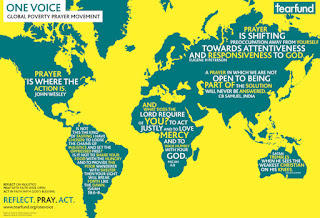
I've recently heard three rather different examples: a super talk by a young woman from TearFund (which is where the picture came from, click on it to see a larger, clearer version); a less super claim at a religious concert that 'my God is wealthy enough to deal with all your debts' (in a slightly grating Belfast accent); and the, at best ambivalent, suggestion shortly after Christmas that if your credit card is maxed out then 'take it to the Lord in prayer and stop worrying' (that one in a Yorkshire accent, as it happens).

In a previous recession I myself had a fairly serious credit card problem - the 'take money out of one card to make the minimum payment on the other' game. Burying one's head in the sand is a classic response to debt, so the suggestion that one can simply tell God about it then carry on ignoring the debt is really not a helpful one. On the other hand, talking to God about the problem and your worries then listening to what God says and acting on it - probably to DO something about the debt - and trusting Him enough to stop worrying whilst you act ... that's a different matter. So I call the suggestion 'ambivalent' because whilst the preacher may have meant the active latter, I strongly suspect many of his listeners heard the passive former.

It's not just 'doing' though: typically real, two-way, prayer results in change - change in attitude and change in approach. To forgive someone when they have really harmed us is incredibly difficult, and often takes a long time. But not forgiving continues to cause further harm. Prayer and change of heart go together: the journey may be long and hard but, in prayer, God is with you all the way.

Of the various quotes featured on TearFund's 'Reflect, Pray, Act' poster, my favourite is from CB Samuel: "A prayer in which we are not open to being part of the solution will never be answered". God is not our gofer  - He helps us, encourages us, supports us, wants us to grow and wants us to take responsibility for our actions. The Church is meant to be Jesus' hands and feet, heart and mouth.

The expectation in any prayer should be that God will respond and that we will be asked to take part: sometimes by waiting trustfully, sometimes by resting in the assurance of His love, sometimes by changing our attitudes, sometimes by saying something that needs to be said, often by changing our behaviour, often by getting our hands dirty. God will be with us throughout, and together we really can change the world for the better. "Your Kingdom come" and all that.

Saturday, 23 April 2011

Love Wins By Rob Bell


When the religious movers and shakers, the guys with the power and the influence, are vigorously driving people away from God with messages about how hateful and judgemental He is, what can you do about it? If you're Jesus, you walk around Galilee and Judea, teaching and healing in the name of God. If you're Rob Bell you write a book. Either way, the intent is to show that God really is a God of love and faithfulness. But in doing so, they also show up the haters as being far, far from God, and they will want their revenge.

The religious right in the US were out even before Love Wins was published - they didn't care what it said, they just wanted to attack Rob Bell. Here in the UK they're not so blatant, but I was interested to read in this month's Christianity magazine an article arguing that without Hell in the message churchgoers wouldn't be able to witness to Jesus. Curiously Greg Downes, the article's author, goes on to say that universalism - the idea that everybody will eventually be saved - only works if certain sections of Scripture are distorted or disregarded. The irony of this line is that Love Wins gives a lot of examples of Bible passages which Downes has to ignore or distort to dismiss the universalist position. Actually, I think Love Wins is probably the most overtly Scripture-based book that Bell has written.

Once you read the book, it is clear that Rob Bell is not proposing universalism anyway. What he is doing is pointing out that the Christian faith, the historical sweep of mainstream orthodox Christian thinking, is much broader than the bigots would have you think. Variants of universalism have been around a long time and are not necessarily anti-Biblical. The tension between salvation of a remnant and salvation of the whole world is a Scriptural tension: the range of passages is there and we have to accept that we are not God and we don't know everything. In the meantime we are called to be grace-full and loving in our differing interpretations.

For Bell it is God's love which has the last word, yet God's love allows the freedom to say 'no'. So he is not a universalist, but he does believe that God will give every chance He can for every person to respond by choosing life.

Bell's genius is that he writes very well and very clearly, in a modern open style which avoids the jargon and religious nonsense. He writes for anyone interested in living life better, free-er, deeper; for anyone who recognises a spiritual side to life, but needs more than the Pharisees with their blaring megaphones can offer.

This is very readable and interesting book: I don't agree with everything Bell says, but I do suggest you read it for yourself. I strongly recommend it.

Wednesday, 6 April 2011

Hospices & Healing


Several weeks ago we had an excellent visiting preacher at Caversham Baptist. He preached about healing - which is easy to preach about badly, hard to preach well - and presented it in terms of the Kingdom of God breaking through into our 'ordinary' world. It is unpredictable and often unexpected, but when it does break in you can only wonder and give thanks.

He gave an example of someone he knew who has cancer, of a generally fairly treatable form, and was undergoing chemo. But there was a complication and she had been taken into hospital - very poorly indeed - where she just wasn't responding to treatment. Because she was so poorly they were about to stop the chemo, with long term consequences. The preacher and the young woman's mother prayed for her healing, then he left. A couple of days later, there she was, with her mother, walking into town, looking positively perky.

This story begs a lot of questions, of course. Was it God doing the healing, or was it the treatment at the hospital? If it was God, then why did she still have cancer, and still need the long course of chemo with no guarantee of the result at the end? Why didn't God just fix everything for her ... indeed why not fix it for everyone in the hospital? You could worry about the questions, or you could just look at this young woman who had been really unwell and now was out and about, living freely. And you could just thank God for that.

Some years ago, my wife worked at the Sue Ryder Hospice, out at Nettlebed. They've broadened their clientele a little since, but back then they mostly worked with people suffering from terminal illnesses. This gives a rather different view of what 'healing' means. In hospitals they tend to be mostly concerned with patching up your body and sending you home 'mended'. In hospices dealing with terminal care, the body isn't going to be patched: mending it isn't an option. Instead hospices look at enhanced quality of life, at relationships, at alleviating suffering: at the physical, emotional and spiritual needs of the patient and of their friends and family. Many (although certainly not all) of the staff are Christians who regularly pray. But in most cases praying for longer lives for their patients isn't meaningful, instead they pray for healing and wholeness and peace, as each individual person comes to the end of their life.

At the church service, the preacher did one of those "raise your hand if you want to be prayed for" things. Fair enough, I guess, although I'm not a big fan. Then he did the slightly cringey, "I'm feeling there's someone here who has problems with their right arm" bit. In a congregation of some 80 people, ranging from 20's to 80's or 90's, there's bound to be someone with a sore arm. As it happened that included me, but to be honest I wasn't concerned about anyone praying for my arm. If we were going to have a time of prayer for the Kingdom of God to break through, I had a much higher priority.

Someone I know, and like, and respect, had spiralled completely out of control. Her life had crashed, she was in an utter mess, and it was not at all obvious how she could possibly get out in one piece. So I prayed for her, desperately. A day or two later, there was a development which looked like it was just going to make things worse. In practice, though, it moved her out of her pit of utter despair and into a place where she has the possibility of - slowly and painfully - rebuilding her life. She's not out of the woods by a long shot: sometimes it still looks as if she just wants to lose everything; but still she now has a chance at life and hope and rebuilding. As miracles go it might seem a bit low-key, and maybe it would have happened anyway, but that's no reason for me not to thank God for the change.